
Pass H12-311 Confidently: Banish Exam Day Nerves

The Huawei H12-311 exam, officially known as the Huawei Certified ICT Associate-WLAN (HCIA-WLAN) certification, serves as a crucial benchmark for individuals aiming to validate their foundational knowledge and practical skills in wireless local area network (WLAN) technologies. This certification is specifically designed for those seeking to understand the core principles, deployment strategies, and operational maintenance of enterprise WLANs. It confirms a candidate's ability to navigate the complexities of wireless network planning, implementation, and troubleshooting, making them valuable assets in the evolving landscape of ICT infrastructure. This comprehensive guide will explore the intricacies of the H12-311 exam, detailing its structure, syllabus, benefits, and effective preparation strategies to ensure candidates can confidently achieve certification.
Navigating the HCIA-WLAN Exam Blueprint
The H12-311 certification stands as an entry-level credential within Huawei's extensive certification portfolio, focusing specifically on WLAN technologies. It is ideal for network engineers, IT professionals, and students who wish to establish a strong foundation in wireless networking. Achieving this certification demonstrates a candidate's proficiency in fundamental WLAN concepts, the working principles of wireless networks, access authentication methods, and basic configuration tasks. The exam validates a candidate's readiness to contribute to the design, deployment, and maintenance of enterprise-grade wireless solutions.
The Huawei H12-311 exam syllabus covers a broad spectrum of WLAN topics, ensuring candidates possess a well-rounded understanding. The exam evaluates knowledge across areas from basic WLAN overviews to advanced Wi-Fi 6 technologies and intricate troubleshooting methodologies. Success in this exam signifies a candidate's capability to understand and apply key WLAN principles in real-world scenarios.
Core Examination Details for H12-311
Understanding the fundamental details of the H12-311 exam is essential for any aspiring candidate. These specifics provide a clear picture of what to expect on exam day, allowing for targeted and efficient preparation. The examination is structured to test both theoretical knowledge and practical understanding across various WLAN domains.
The key aspects of the H12-311 exam include:
-
Exam Name: Huawei Certified ICT Associate-WLAN
-
Exam Code: H12-311
-
Exam Price: $200 (USD)
-
Duration: 90 mins
-
Number of Questions: 60
-
Passing Score: 600/1000
These details highlight the time constraint and the required score, emphasizing the need for comprehensive knowledge and efficient time management during the exam. Candidates should familiarize themselves with these parameters to set realistic preparation goals.
Exploring the H12-311 Exam Syllabus Topics
The Huawei H12-311 exam syllabus is meticulously designed to cover a wide array of topics crucial for understanding and implementing modern WLAN solutions. Each topic carries a specific weight, indicating its importance within the examination. A detailed understanding of these topics and their percentages is vital for prioritizing study efforts and ensuring thorough coverage of all examinable areas.
The syllabus topics and their respective weightings are as follows:
-
WLAN Overview - 3%: Introduces the basic concepts of WLAN, its evolution, and general applications in enterprise environments. This section lays the groundwork for understanding wireless networking fundamentals.
-
WLAN Technology Basics - 15%: Delves into the foundational technologies behind WLAN, including IEEE 802.11 standards, wireless communication principles, and various modulation techniques.
-
WLAN Networking Model - 7%: Covers different WLAN networking architectures, such as independent basic service set (IBSS), basic service set (BSS), extended service set (ESS), and their respective deployment models.
-
Introduction to Wi-Fi 6 Technologies and Products - 5%: Provides an overview of the latest Wi-Fi 6 (802.11ax) standard, highlighting its key features, advantages, and associated Huawei products.
-
Working Principles of WLAN - 25%: Focuses on the core operational mechanisms of WLAN, including frame formats, channel access methods (CSMA/CA), roaming, and power saving modes. This is a high-weightage section requiring deep understanding.
-
WLAN access authentication - 5%: Explores various methods of securing WLAN access, such as 802.1X, MAC address authentication, and Portal authentication, critical for network security.
-
WLAN Access Configuration - 20%: Covers the practical aspects of configuring WLAN devices, including APs, ACs, and clients, to establish and manage wireless connectivity. This practical component is highly significant.
-
WLAN Troubleshooting - 10%: Addresses common issues encountered in WLAN environments and provides methodologies for identifying and resolving them, essential for maintaining network reliability.
-
WLAN Antenna Technology - 5%: Explains the different types of antennas used in WLAN, their characteristics, and how to select the appropriate antenna for various deployment scenarios.
-
WLAN Deployment Overview - 5%: Offers insights into the planning and considerations involved in deploying WLAN infrastructure, including site surveys and capacity planning.
These topics underscore the exam's emphasis on both theoretical knowledge and practical configuration and troubleshooting skills. Candidates should dedicate significant study time to the "Working Principles of WLAN" and "WLAN Access Configuration" sections due to their high weighting.
Gaining Professional Edge: Benefits of HCIA-WLAN Certification
Attaining the Huawei Certified ICT Associate-WLAN certification provides numerous advantages for IT professionals looking to advance their careers in networking. This credential not only validates a specialized skill set but also opens doors to enhanced career opportunities and professional recognition within the industry. The benefits extend beyond individual career growth, impacting organizational efficiency and technological capabilities.
Validating Expertise in Wireless Technologies
The HCIA-WLAN certification serves as tangible proof of a candidate's fundamental competence in wireless networking. It assures employers that the certified individual possesses a clear understanding of WLAN principles, from basic architecture to advanced Wi-Fi 6 features. This validation is critical in a competitive job market, distinguishing candidates with verified skills in an increasingly wireless-dependent world. Employers often prioritize candidates who hold industry-recognized certifications, as they reduce the risk associated with hiring and training.
Enhancing Career Opportunities and Growth
With the proliferation of wireless devices and networks, the demand for skilled WLAN professionals continues to grow. Holding the HCIA-WLAN certification positions individuals for various roles, including network administrator, wireless engineer, or IT support specialist focused on wireless infrastructure. It can lead to promotions, higher earning potential, and the chance to work on more complex and challenging projects. This certification acts as a stepping stone for further specialization within Huawei's advanced certification tracks, such as HCIP and HCIE. Exploring available career paths can provide further insight into the long-term value of this certification.
Contributing to Organizational Efficiency and Security
Certified professionals are better equipped to design, deploy, and manage robust and secure WLANs. Their expertise helps organizations optimize network performance, minimize downtime, and implement effective security measures against wireless threats. This directly translates into improved operational efficiency, reduced IT costs, and enhanced data protection. For businesses, having HCIA-WLAN certified staff ensures adherence to best practices and industry standards, which is vital for maintaining a competitive edge.
Strategic Preparation for Huawei H12-311 Success
Effective preparation is the cornerstone of success for the H12-311 exam. A well-structured study plan, combined with the right resources and a disciplined approach, can significantly boost confidence and readiness. Given the exam's scope and the specific weighting of its topics, a targeted strategy is crucial for mastering the content and avoiding common pitfalls.
Building a Solid Study Plan
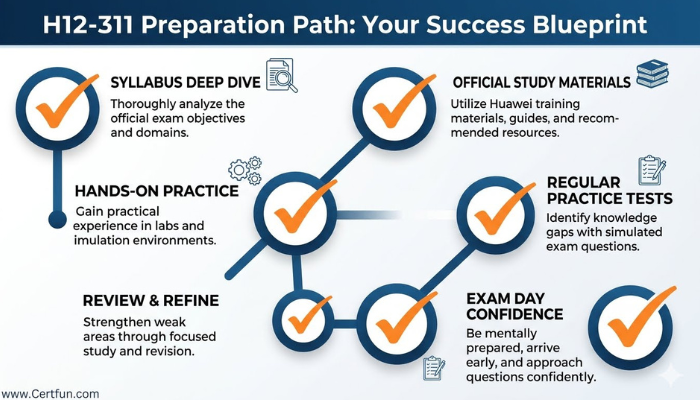
The initial step in preparing for the Huawei H12-311 is to develop a comprehensive study plan. This involves:
-
Reviewing the Official Syllabus: Begin by thoroughly understanding each topic listed in the Huawei H12-311 exam syllabus and its percentage weighting. This guides your focus, ensuring more time is allocated to high-weightage areas like "Working Principles of WLAN" and "WLAN Access Configuration."
-
Gathering Study Materials: Collect official Huawei training documentation, recommended textbooks, whitepapers, and reputable online courses. Huawei's official website provides valuable resources that align directly with the exam objectives. You can refer to the official certification page for recommended study paths and materials.
-
Setting a Realistic Schedule: Break down the syllabus into manageable sections and assign specific study hours for each. Be realistic about the time required to understand complex topics and incorporate regular review sessions.
Consistency is key. Adhere to your schedule as much as possible, making adjustments as needed based on your progress and understanding.
Leveraging Practice Tests and Labs
Theoretical knowledge alone is often insufficient for passing certification exams. Practical experience and familiarity with the exam format are equally important.
-
Engaging with Practice Tests: Utilize H12-311 practice tests to familiarize yourself with the question types, time constraints, and overall exam environment. These tests help identify knowledge gaps and areas requiring further study. Quality practice questions, like those found on Certfun.com, can simulate the actual exam experience effectively.
-
Hands-on Lab Experience: Where possible, gain practical experience with Huawei WLAN equipment. Configuring access points (APs), access controllers (ACs), and implementing various authentication methods in a lab environment reinforces theoretical concepts and builds confidence in troubleshooting scenarios. This is particularly beneficial for the "WLAN Access Configuration" section. You can find useful documentation and support on the Huawei support portal for enterprise users.
Regularly testing your knowledge and applying concepts practically can significantly improve retention and performance. Avoid relying on unethical "certification dumps" as they do not foster genuine understanding or long-term skill development, often leading to failure and undermining the value of the certification.
Mastering Key WLAN Concepts
Given the emphasis on "Working Principles of WLAN" and "WLAN Access Configuration," a deep dive into these areas is non-negotiable.
Understanding Wireless Fundamentals
This involves grasping the intricacies of wireless communication, including different frequency bands, channel planning, interference management, and the functioning of various 802.11 standards. Pay close attention to topics like CSMA/CA, how it mitigates collisions in a wireless medium, and the nuances of client roaming within an ESS.
Configuring Enterprise WLAN Solutions
Practical configuration skills are paramount. Candidates should be comfortable with:
-
Deploying basic and advanced WLAN architectures.
-
Configuring SSIDs, security policies (WPA2/WPA3), and guest access.
-
Implementing different authentication methods, such as 802.1X with RADIUS servers.
-
Managing APs and ACs through various interfaces (CLI, GUI).
These skills are directly applicable to real-world scenarios and heavily tested in the exam.
Solving WLAN Challenges: Troubleshooting and Optimizing Performance
A significant portion of the H12-311 exam focuses on troubleshooting, which is a critical skill for any WLAN professional. Understanding how to diagnose and resolve common wireless network issues ensures reliable and efficient operation. This section prepares candidates to tackle real-world problems effectively.
Identifying Common WLAN Issues
WLAN environments are susceptible to a variety of problems that can impact performance and connectivity. These often include:
-
Signal Interference: Caused by other wireless devices, environmental factors, or overlapping channels. Understanding how to identify and mitigate interference is crucial for maintaining signal quality.
-
Connectivity Problems: Clients unable to connect to the network, intermittent disconnections, or slow speeds. These issues often stem from incorrect configurations, authentication failures, or poor signal strength.
-
Performance Bottlenecks: Sluggish network response times, especially during peak usage. This could be due to insufficient bandwidth, improper AP placement, or an excessive number of clients on a single AP.
-
Authentication Failures: Users unable to gain access despite correct credentials, often indicating issues with the RADIUS server, 802.1X configuration, or client-side settings.
A systematic approach to diagnosing these issues is essential, starting from physical layer checks to application layer verification.
Implementing Effective Troubleshooting Techniques
To efficiently resolve WLAN issues, a structured methodology is highly recommended.
-
Utilize Monitoring Tools: Employ network monitoring tools and the diagnostic features of Huawei ACs and APs to gather real-time data on network performance, client connections, and error rates.
-
Verify Configurations: Cross-check all relevant configurations on APs, ACs, and authentication servers. A common cause of issues is a misconfigured SSID, VLAN, or security setting.
-
Check Physical Layer: Inspect antenna connections, cable integrity, and power supply to ensure there are no physical impediments. Conduct site surveys to evaluate signal strength and identify potential dead zones.
-
Analyze Logs: Review system logs on network devices and authentication servers for error messages or events that indicate the root cause of the problem.
-
Isolate the Problem: Systematically narrow down the problem domain by testing different components, clients, or network segments to pinpoint the exact source of the issue.
Mastering these techniques will not only help in the exam but also provide invaluable skills for a professional career in WLAN management.
Charting a Course: Career Opportunities with HCIA-WLAN
The Huawei Certified ICT Associate-WLAN certification opens doors to a diverse range of career opportunities within the dynamic field of information and communication technology. As wireless connectivity becomes increasingly integral to businesses globally, professionals with validated WLAN skills are highly sought after. This certification serves as a foundational credential for those looking to build a career focused on wireless network infrastructure.
Roles Benefiting from HCIA-WLAN
Individuals holding the HCIA-WLAN certification are well-suited for roles that require a strong understanding of wireless network deployment, operation, and maintenance. Common job titles include:
-
Network Engineer: Responsible for designing, implementing, and managing an organization's computer networks, with a specific focus on integrating wireless solutions.
-
WLAN Administrator/Specialist: Dedicated to the day-to-day management, monitoring, and troubleshooting of wireless networks, ensuring optimal performance and security.
-
IT Support Technician: Providing first-line technical assistance for network-related issues, often including wireless connectivity problems for end-users.
-
Pre-sales Technical Support: Assisting sales teams by providing technical expertise on Huawei WLAN products and solutions to potential clients, designing preliminary network architectures.
-
Post-sales Field Engineer: Involved in the on-site deployment, configuration, and maintenance of wireless networks, ensuring client satisfaction and system reliability.
These roles highlight the practical application of the knowledge gained through the H12-311 exam, making certified professionals immediately valuable to employers.
Advancing Your Expertise in Wireless Networking
The HCIA-WLAN certification is often the starting point for a more specialized career trajectory in wireless technology. It lays the groundwork for pursuing higher-level Huawei certifications, such as:
-
HCIP-WLAN (Huawei Certified ICT Professional-WLAN): Focuses on complex WLAN planning, optimization, and advanced troubleshooting.
-
HCIE-WLAN (Huawei Certified ICT Expert-WLAN): The highest level, demonstrating expert-level knowledge and practical skills in enterprise WLAN solution design, implementation, and maintenance.
By continuing to build upon the foundational skills learned for the H12-311 exam, professionals can progressively enhance their expertise and qualify for more senior and strategic roles within the ICT industry. This continuous learning path ensures relevance and adaptability in a rapidly evolving technological landscape.
Concluding Your Journey to H12-311 Certification
The Huawei H12-311 certification is more than just an exam; it's an investment in your professional future, equipping you with essential skills for the pervasive world of wireless networking. By meticulously preparing, understanding the syllabus, and leveraging the right resources, you can confidently approach exam day and achieve your certification goal. The journey to becoming an HCIA-WLAN certified professional is a commitment to continuous learning and technical excellence, paving the way for numerous opportunities in the ICT sector.
Embark on your certification journey today and unlock your potential in wireless technology. For comprehensive preparation materials, including H12-311 exam questions and answers and practice tests that mirror the real exam experience, visit Certfun.com. Invest in your expertise and take the definitive step towards mastering Huawei WLAN technologies.
FAQs
1. What is the Huawei H12-311 certification about?
The Huawei H12-311 exam leads to the Huawei Certified ICT Associate-WLAN (HCIA-WLAN) certification, which validates foundational knowledge and skills in WLAN technologies, including planning, deployment, operation, and maintenance of enterprise wireless networks.
2. Who should consider taking the HCIA-WLAN (H12-311) exam?
The HCIA-WLAN (H12-311) exam is ideal for network engineers, IT professionals, college students, and anyone aspiring to work with wireless networks. It suits those looking to establish fundamental competence in Huawei's WLAN solutions and gain an entry-level certification in the field.
3. What are the prerequisites for the H12-311 exam?
There are no formal prerequisites specified for the H12-311 exam. However, a basic understanding of general networking concepts and a keen interest in wireless technologies are highly recommended to facilitate effective preparation.
4. How should I prepare for the Huawei H12-311 exam?
Effective preparation involves studying the official syllabus topics, utilizing Huawei's recommended training materials, gaining hands-on experience with WLAN configurations if possible, and consistently practicing with reliable H12-311 practice tests. Focus particularly on high-weightage sections like WLAN working principles and configuration.
5. What career benefits can I expect after passing the HCIA-WLAN certification?
Passing the HCIA-WLAN certification can enhance your career prospects by validating your expertise in wireless networking, leading to roles such as WLAN administrator, network engineer, or IT support specialist. It also serves as a strong foundation for pursuing higher-level Huawei certifications and advancing your career in ICT.
- Huawei Certification |
- Huawei ICT Infrastructure Certification |
- Huawei Certified ICT Associate-WLAN |
- H12-311 HCIA-WLAN |
- H12-311 Online Test |
- H12-311 Questions |
- H12-311 Quiz |
- H12-311 |
- Huawei HCIA-WLAN Certification |
- HCIA-WLAN Practice Test |
- HCIA-WLAN Study Guide |
- Huawei H12-311 Question Bank |
- HCIA-WLAN Certification Mock Test |
- HCIA-WLAN Simulator |
- HCIA-WLAN Mock Exam |
- Huawei HCIA-WLAN Questions |
- HCIA-WLAN |
- H12-311 Syllabus |
- HCIA-WLAN Books |
- HCIA-WLAN Certification Syllabus |
- Huawei H12-311 Books |
- Huawei HCIA-WLAN Training |
- HCIA-WLAN Certification Cost |
- HCIA-WLAN Sample Questions |
- Huawei H12-311 Practice Test Free |
- HCIA-WLAN Certification Sample Questions


