
H14-211 HCIA-HarmonyOS Application Developer Syllabus, Practice Test and Study Plan
The H14-211 exam is the Huawei Certified ICT Associate-HarmonyOS Application Developer test. As of October 2026 it costs 200 USD, runs 90 minutes, asks 60 questions and needs 600 out of 1,000 to pass. This guide walks through the seven syllabus domains, a six-week study plan and the way a timed H14-211 practice exam fits into the last two weeks.
What does the H14-211 exam certify, and who should sit it?
H14-211 is the associate-level HarmonyOS application developer credential in Huawei's career certification ladder. Huawei places it in the Basic Software & Hardware category, and the current version is V1.0. Passing it says that you can set up DevEco Studio, write a HarmonyOS application in ArkTS, build its interface with ArkUI, manage the lifecycle of its abilities, talk to the network, store data on the device and ship an ArkTS widget. In Huawei's own wording it checks fundamental knowledge and proven skills, which at this level means recognising the right API, the right decorator and the right lifecycle hook when you see it, rather than architecting a product from scratch.
The exam is aimed at three kinds of readers. The first is a mobile developer with Android or iOS experience who has been asked to port or build a HarmonyOS version of an existing app and wants a recognised line on the CV. The second is a university student or recent graduate in a market where HarmonyOS devices are common, for whom the associate certificate is an entry ticket to campus hiring. The third is a web or front-end developer who already thinks in components and state, because ArkTS borrows much of that mental model from TypeScript and declarative UI frameworks. If you have never written a line of TypeScript, budget extra time for the ArkTS domain; everything else in the syllabus is reachable from general programming knowledge.
Two things the exam is not. It is not a test of the HarmonyOS kernel, device drivers or distributed soft bus internals; those belong to other Huawei tracks. And it is not a coding exam. The outline lists no lab or hands-on task, only a fixed set of 60 questions in 90 minutes, so your preparation should be aimed at reading code and recognising behaviour, not at typing it under pressure.
H14-211 exam facts as of October 2026
The facts below come from Huawei's published exam outline as carried on the CertFun syllabus page. Prices and formats do change between versions, so treat the table as a dated snapshot and confirm the fee on the Huawei Talent portal before you book.
| Item | Detail |
|---|---|
| Exam name | Huawei Certified ICT Associate-HarmonyOS Application Developer |
| Exam code | H14-211 |
| Version | V1.0 |
| Exam fee | 200 USD (as of October 2026) |
| Duration | 90 minutes |
| Number of questions | 60 |
| Passing score | 600 out of 1,000 |
| Booking | Pearson VUE |
The arithmetic matters for your pacing. Sixty questions in ninety minutes is a minute and a half per question, and the scaled passing mark of 600 out of 1,000 is usually read as needing roughly six questions in ten right. That is a forgiving bar for anyone who has actually built a small HarmonyOS app, and an unforgiving one for anyone relying on memorised terminology, because the syllabus is built around ArkTS syntax, decorators and lifecycle behaviour that you can only recognise reliably if you have used them. Huawei does not publish the exact number of scored versus unscored items, and CertFun does not guess at it, so plan as if every question counts.
The exam is scheduled through Pearson VUE. Check the delivery options, the retake rules and how results are reported on the Huawei Talent portal before you book, because Huawei sets those per exam and changes them over time. A failed attempt means paying the fee again, which is the main financial argument for sitting a practice test before you book.
How is the H14-211 syllabus weighted across its seven domains?
The outline has seven topics. Three of them, ArkTS, Ability Kit and ArkUI, carry 20 percent each and together make up 60 percent of the paper. The other four, HarmonyOS Overview, Introduction to Application Development, Network Service and Data Management, and Form Kit, carry 10 percent each. On a sixty-question paper that is roughly twelve questions for each heavy domain and six for each light one.
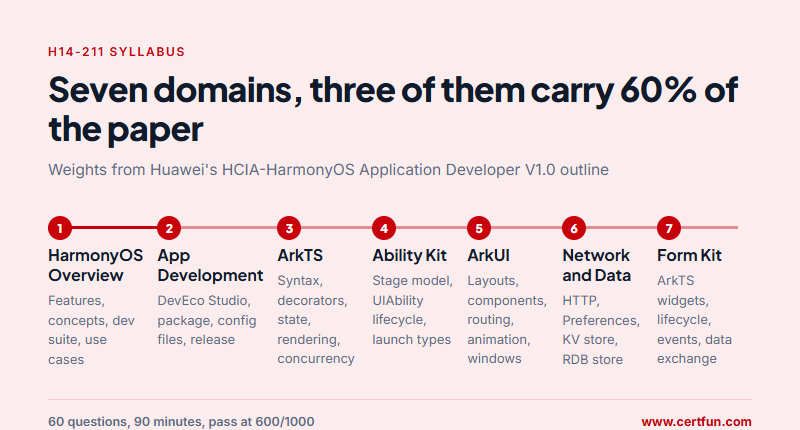
| Domain | What it covers | Weight |
|---|---|---|
| HarmonyOS Overview | Introduction, features, technical concepts, development suite, use cases | 10% |
| Introduction to Application Development | DevEco Studio, compilation tools, application package, configuration files, release | 10% |
| ArkTS | Basic syntax, UI description, common decorators, state management, rendering control, concurrency, container classes | 20% |
| Ability Kit | Stage model, UIAbility component, lifecycle and launch types, data sync with the UI page, starting abilities, inter-application redirection | 20% |
| ArkUI | Layout and common components, page routing and navigation, graphics and animation, window management | 20% |
| Network Service and Data Management | Network management, HTTP requests, ArkData, Preferences, KV store, RDB store | 10% |
| Form Kit | ArkTS widgets, their lifecycle, configuration, page and event development, data exchange | 10% |
HarmonyOS Overview is the only domain you can prepare from reading alone. Expect questions on what distinguishes HarmonyOS from a conventional single-device operating system, the names of the layers in its technical architecture, what the development suite contains and the kinds of device and scenario it is built for. Six questions is not many, so read this material once, note the vocabulary and move on.
Introduction to Application Development is about the tooling. You need to know what DevEco Studio does, how a project is compiled and packaged, what the application package contains and what the configuration files declare. The release sub-topic covers how a finished package is signed and submitted. Candidates who have actually created a project and run it on the emulator find these questions easy; candidates who have only read about it find the configuration-file questions surprisingly specific.
ArkTS is the language domain and the one that decides most results. The syllabus lists getting started, basic syntax, UI description specifications, common decorators, state management, rendering control, concurrency and the container class library. The decorator and state management items are where TypeScript developers gain an edge and everyone else loses points: you must know which decorator holds component-local state, which one receives a value from a parent, which one synchronises in both directions and which one reaches across the whole component tree. Rendering control questions ask how conditional and list rendering are expressed, and the concurrency items check that you know the model for running work off the main thread.
Ability Kit covers how an application is structured at runtime. The stage model, the UIAbility component, its lifecycle states and launch types, how data moves between a UIAbility and its page, how one ability starts another and how one application redirects to another are all listed. Lifecycle ordering is a classic exam item: given a sequence of user actions, which callbacks fire and in what order. Draw the lifecycle diagram from memory until you can.
ArkUI is the interface domain. Layout components, common components, page routing, component navigation, graphics and animation, and window management are the sub-topics. Here the questions tend to be practical, for example which container arranges children in a column versus a row, how a page route is pushed and popped, and what an animation API expects as parameters.
Network Service and Data Management pairs HTTP requests with on-device storage. You need to know the HTTP request flow and the three storage options the syllabus names: Preferences for small key value settings, the KV store for key value data that can sync, and the RDB store for relational data. A common item describes a storage need and asks which store fits it.
Form Kit is about ArkTS widgets, the small cards that live on the home screen. You should understand how a widget is created, how its configuration file and lifecycle differ from a full page, how its page and events are developed and how it exchanges data with the host application. This is a short domain, but it is the one most candidates have never touched in a real project, so it needs deliberate study rather than being picked up along the way.
Which H14-211 domains are hardest for candidates from an Android or web background?
Android developers usually find Ability Kit both familiar and treacherous. The stage model and UIAbility lifecycle rhyme with activities and their callbacks, so the temptation is to answer from Android memory. The names, the number of states and the launch type semantics are not the same, and the exam writers know where the two worlds diverge. The fix is simple but boring: learn the HarmonyOS lifecycle on its own terms and stop translating.
Web and front-end developers have the opposite profile. ArkTS and ArkUI feel natural because declarative components, decorators and reactive state are everyday concepts, and the container class library is a short read. Their weak spots are Form Kit, because nothing in a browser works like a home screen widget, and the packaging and signing parts of Introduction to Application Development, which have no web equivalent.
Candidates coming from backend or embedded work tend to struggle with ArkTS state management and ArkUI layout, and do well on Network Service and Data Management, where the HTTP and storage concepts are universal. Whatever your background, score a diagnostic practice test by domain before you plan your study weeks, and give the two weakest domains twice the time of the others. The syllabus weights tell you where the marks are; the diagnostic tells you where your marks are missing.
A six-week H14-211 study plan that follows the weights
Six weeks at roughly eight to ten hours a week is enough for a working developer who can already code. The plan below gives the three heavy domains a week each, folds the four light domains into two weeks, and keeps the last week for timed practice and review. Shift the order to put your weakest heavy domain first so it gets the most revision passes.
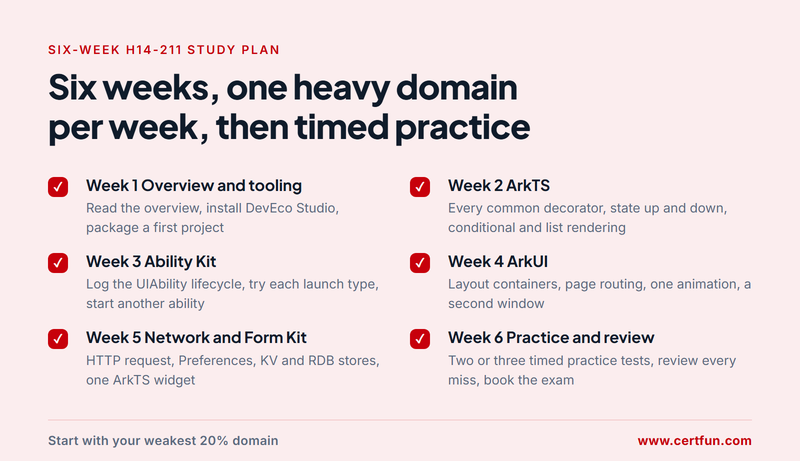
- Week 1, Overview and tooling. Read the HarmonyOS Overview material once. Install DevEco Studio, create a project, inspect the generated package and configuration files, run it on the emulator and walk through the release flow as far as signing. Write down every file name and field you meet; the exam asks about them.
- Week 2, ArkTS. Work through the basic syntax, then build a two-component screen that uses each common decorator at least once. Make a parent pass a value down, a child send one up and a shared value reach a grandchild. Add a conditional block and a list, then move a slow loop off the main thread.
- Week 3, Ability Kit. Add a second UIAbility to the project, log every lifecycle callback and watch the order as you background, foreground and close the app. Try each launch type and note how it changes the instances you see. Start one ability from another, then redirect to a system application.
- Week 4, ArkUI. Rebuild your screens with the layout containers in the syllabus, add page routing between two pages and component navigation inside one, animate a property change and open a second window. Keep the official component reference open and read the parameter lists, because the exam quotes them.
- Week 5, Network, data and Form Kit. Make an HTTP request and render the response. Store a setting in Preferences, a cache in the KV store and a table in the RDB store, and be able to say why each one fits. Then build one ArkTS widget, wire its events and pass data to and from the host app.
- Week 6, practice and review. Sit two or three full-length timed practice tests, review every wrong answer back to the syllabus line it came from, and reread only those lines. Book the real exam for the end of the week while the material is fresh.
The guiding rule is that every syllabus bullet should map to something you have personally done in DevEco Studio. The exam rewards recognition, and recognition comes from having seen the code behave, not from having read that it does.
Which study resources are worth your time for H14-211?
Start with the official material. Huawei's HCIA-HarmonyOS Application Developer V1.0 training content is the document the exam is written from, and the Huawei Developer portal carries the ArkTS, ArkUI and Ability Kit references you will need open while you build. Those two sources cover every line of the syllabus. Where the training content reads as a lecture, the developer documentation gives you the parameter lists and code samples the questions are built around.
Next, make the syllabus itself a working document. The HCIA-HarmonyOS Application Developer exam syllabus page on this site lists every sub-topic under each of the seven domains with its weight. Print it or copy it into a checklist and tick a line only when you have built something that uses it. A ticked syllabus is a better readiness signal than any number of hours logged.
Third, use sample items early to calibrate difficulty. The free H14-211 sample questions on this site show the style of question CertFun's community writes to this syllabus: a short scenario or code fragment, several options and often one distractor that would be right for Android or the web but is wrong for HarmonyOS. Reading ten of them in week one tells you how precisely you need to learn the material, which changes how you read everything afterwards.
What to leave out: so-called dumps. Beyond the obvious policy problem, questions copied from a live paper go stale as soon as Huawei rotates the pool, and memorising answers teaches none of the recognition skills the real paper tests. Nothing CertFun offers is Huawei material; the practice exam here is written by the community to the published syllabus and weights, and it is a rehearsal tool, not a shortcut.
How should you use an H14-211 practice test in the final two weeks?
A practice test does three jobs, and each needs a different sitting. The first sitting, at the start of week five, is a diagnostic. Take it untimed, do not look anything up, and score it by domain against the seven syllabus headings. The result tells you where the remaining study hours go. Most candidates discover that one of the three heavy domains is much weaker than they assumed.
The second and third sittings, in week six, are rehearsals. Take them under exam conditions: 90 minutes, 60 questions, no notes, no pauses. The aim here is pacing and stamina rather than new knowledge. If you finish with fifteen minutes to spare, you can afford to slow down and reread the long code items. If you run out of time, practise marking a question and moving on after the ninety-second budget is spent.
After every sitting, the review is where the marks are made. For each wrong answer, write the syllabus line it belongs to and one sentence on why the correct option is correct. Patterns appear quickly: three errors in a row on launch types, or a habit of picking the Android-flavoured distractor. The CertFun practice platform keeps a result history for exactly this purpose, so you can see the domain scores move from one attempt to the next. When two consecutive timed attempts clear the 600 mark with margin, book the exam.
Finally, a word about scores. A practice score is not a prediction of the real result, because the item pool is different and the real paper's scaling is Huawei's. Treat it as a readiness threshold and a map of weak spots, nothing more. Candidates who pass comfortably in practice and then fail are rare; candidates who skip the review step and keep retaking until the score looks good are the ones who get a surprise on the day.
What does HCIA-HarmonyOS Application Developer certification do for your career?
The certificate is most valuable where HarmonyOS devices are: in markets and companies that ship apps to Huawei phones, tablets, wearables and smart screens. For a developer in those markets it is a hiring filter and sometimes a vendor requirement. Outside them it signals something broader, which is that you can learn a new declarative UI stack and a new application model from first principles and prove it under exam conditions. Hiring managers who have never seen a HarmonyOS device still understand that signal.
Within Huawei's career certification structure, the associate level is the first of three. Holding H14-211 is the natural step before the professional level in the same track and sits alongside Huawei's other associate credentials in areas such as cloud, storage and networking. Because the certificate is version specific, keep an eye on Huawei's recertification policy and on when V1.0 is superseded, and plan an update sitting before your credential lapses.
If you are deciding whether to sit it at all, the practical test is this: will you build or maintain a HarmonyOS application in the next two years? If yes, the six weeks of preparation are hours you would spend learning the platform anyway, and the exam simply gives them a deadline and a certificate. If no, the material is still a good education in modern declarative app development, but the fee buys you less.
Next step
Read the seven domains on the syllabus page, install DevEco Studio this week and start the six-week plan from your weakest heavy domain. When you reach week five, sit the H14-211 practice exam as a diagnostic, use the result history to steer the last fortnight, and book the real exam once two timed attempts clear 600 with room to spare.
Frequently Asked Questions
How much does the H14-211 exam cost and how long is it?
As of October 2026 the H14-211 exam fee is 200 USD. The exam lasts 90 minutes and has 60 questions, with a passing score of 600 out of 1,000. A failed attempt means paying the fee again, so a timed practice test before booking is the cheapest insurance.
Which H14-211 syllabus domains carry the most weight?
ArkTS, Ability Kit and ArkUI each carry 20 percent, together 60 percent of the paper. The remaining four domains, the overview, the tooling, networking with data storage, and Form Kit, are weighted at 10 percent apiece. Expect about twelve items per heavy domain and six per light one.
Do I need to know TypeScript before studying for H14-211?
Not strictly, but it helps. ArkTS extends TypeScript with decorators and a declarative UI syntax, and the ArkTS domain is 20 percent of the exam. Developers without TypeScript should add a week for basic syntax, types and classes before starting the decorator and state management topics.
Is there a coding or lab section in the H14-211 exam?
Huawei's outline lists no lab or hands-on task: H14-211 is 60 questions in 90 minutes, booked through Pearson VUE. The syllabus still centres on ArkTS code, decorators and lifecycle behaviour, so building a small HarmonyOS app is the surest way to recognise the right answer.
How long should I prepare for the HCIA-HarmonyOS Application Developer exam?
A working developer who can already code needs about six weeks at eight to ten hours a week. Give the three heavy domains a week each, fold the four light domains into two weeks, and keep the last week for timed practice tests and review of every wrong answer.
Is the CertFun H14-211 practice exam official Huawei material?
No. Nothing CertFun offers is Huawei material. The practice exam is written by the community to the published syllabus, question count, duration and weights, and it is meant as a diagnostic and timed rehearsal tool alongside Huawei's own training content and developer documentation.
- Huawei Certified ICT Associate-HarmonyOS Application Developer |
- HCIA-HarmonyOS Application Developer Practice Test |
- H14-211 Syllabus |
- Huawei HCIA-HarmonyOS Application Developer Training |
- HCIA-HarmonyOS Application Developer Certification Cost |
- HCIA-HarmonyOS Application Developer Sample Questions


