
EAEP_2025 ArcGIS Enterprise Administration Professional Exam: Syllabus Weights, Practice Test and Eight-Week Plan
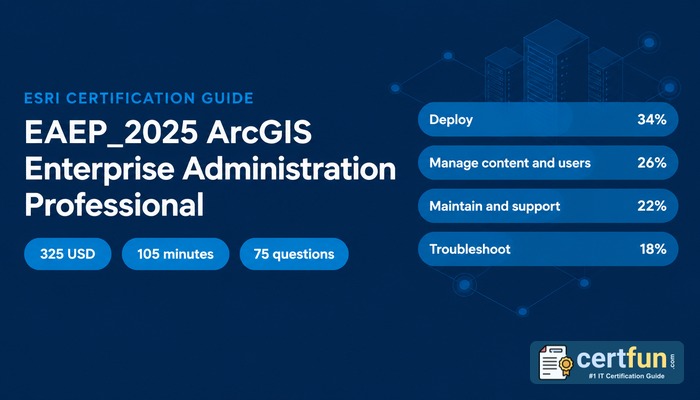
EAEP_2025 is the Esri Certified ArcGIS Enterprise Administration Professional 2025 exam. As of October 2026 the voucher costs 325 USD, the sitting lasts 105 minutes, there are 75 questions and the result is a plain pass or fail. Below you will find the four weighted syllabus domains, the scenarios Esri likes to test, an eight-week preparation plan and the point at which a timed EAEP_2025 practice exam earns its place.
What does the EAEP_2025 exam certify, and who should take it?
EAEP_2025 sits at the professional tier of Esri's technical certification programme, above the associate exams and alongside the other professional-level tracks for developers and desktop analysts. Esri describes it as validating the skills needed to deploy ArcGIS Enterprise, to configure, maintain and troubleshoot its core components, and to manage updates to the software and the services running on it. The published expectation is four years of experience applying those skills in support of enterprise GIS workflows, which tells you the kind of candidate the question writers had in mind: someone who has installed Portal for ArcGIS, ArcGIS Server, ArcGIS Data Store and the Web Adaptor more than once, has federated a server, has been paged when a hosting server stopped publishing, and has lived through at least one version upgrade.
Three groups get the most from this credential. GIS administrators inside government agencies, utilities and natural-resource companies, where ArcGIS Enterprise is the system of record and the administrator is a role rather than a side duty. Consultants and systems integrators who stand up Enterprise deployments for clients and need a line on the proposal that an evaluator recognises. And IT infrastructure staff, often from a Windows or Linux server background, who inherited the GIS stack and want a structured way to prove they understand the Esri-specific parts, from federation and authorisation files to the behaviour of the relational data store.
Two things the exam does not cover. It is not an ArcGIS Online administration test, even though the portal interface looks similar; the online administration track has its own associate exam. And it is not a cartography or analysis exam. You will not be asked to symbolise a layer or run a geoprocessing tool, but you will be asked what happens to a published service when the registered data source changes and how you would find out from the logs.
EAEP_2025 exam facts as of October 2026
Every figure in this table comes from Esri's exam page and the matching EAEP_2025 syllabus page, both checked in October 2026. Esri lists the publication date of this exam version as November 2025, so it is the current release rather than a soon-to-retire one.
| Item | Detail |
|---|---|
| Exam name | Esri Certified ArcGIS Enterprise Administration Professional 2025 |
| Exam code | EAEP_2025 |
| Exam level | Professional |
| Voucher price | 325 USD (as of October 2026) |
| Duration | 105 minutes |
| Number of questions | 75 |
| Scoring | Pass / Fail |
Seventy-five questions in 105 minutes works out to 84 seconds a question. That sounds generous until you meet the scenario items, which describe a deployment in four or five sentences, give you a symptom and ask for the most likely cause or the correct next action. Those need a full read, and a pass-or-fail result means you cannot tell afterwards how close you were. Esri does not publish a percentage threshold for this exam, so the only sensible target is to be comfortable across all four domains rather than hoping two strong ones carry two weak ones.
The exam is delivered through Pearson VUE, at a test centre or by online proctoring. Esri's exam page for ArcGIS Enterprise Administration Professional 2025 links the Exam Information Guide, which is the document to read first: it lists the skills measured domain by domain, and the exam follows it closely. Esri's general certification programme page carries the current rules on scheduling, rescheduling and retaking, which change from time to time and are worth checking the week you book.
How is the EAEP_2025 syllabus weighted across its four domains?
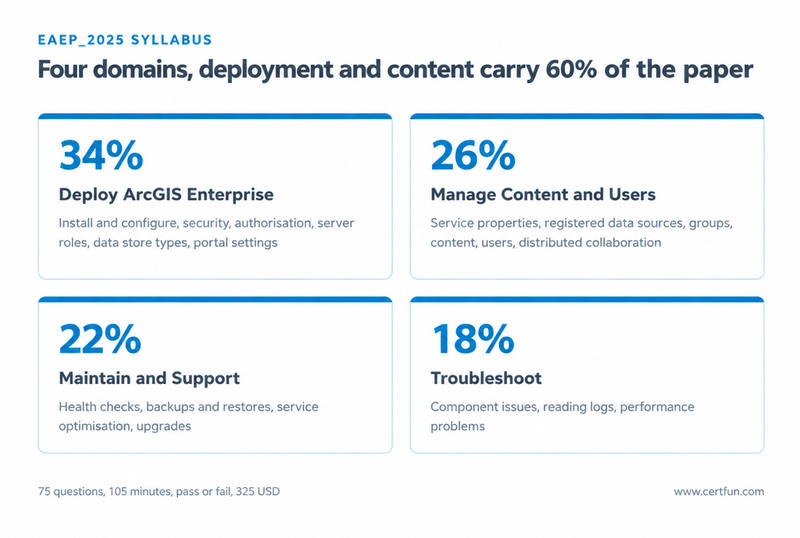
The 2025 outline has four domains, and they are not equal. Deployment is the largest at 34 percent, followed by managing content and users at 26 percent, maintenance and support at 22 percent, and troubleshooting at 18 percent. Added together, deployment and content management are 60 percent of the paper, so a candidate who knows installation, security configuration and sharing cold is already most of the way there. The breakdown below follows the published syllabus.
Deploy ArcGIS Enterprise (34 percent)
The biggest domain and the one that rewards hands-on experience most directly. Esri expects you to apply its guidelines to install and configure a deployment, to configure security, to authorise the software, to choose the right ArcGIS Server roles and the right ArcGIS Data Store types for a stated requirement, and to explain the portal organisation settings. In practice that means knowing the base deployment inside out: a portal, a hosting server federated to it, a relational data store and usually a tile cache data store, with Web Adaptors in front. It also means recognising when a requirement calls for an additional server role, such as an image server for raster analytics or a dedicated GIS Server site for heavily used map services, and when a spatiotemporal or object store is the right data store to add.
Manage content and users in ArcGIS Enterprise (26 percent)
This domain covers the daily life of the portal once it is up. Configuring service capabilities and properties so that a feature service does what its users need, registering on-premises and cloud data sources with the server so that services reference data rather than copy it, managing groups and content, managing users and their roles and licences, and setting up distributed collaboration between portals or between a portal and ArcGIS Online. Questions here are often phrased from the user's side: a group cannot see a layer, a service was published with copied data by mistake, a collaboration workspace is not syncing. You are expected to name the setting that fixes it.
Maintain and support ArcGIS Enterprise (22 percent)
Health checks and stability, backups and restores, service optimisation and upgrades. Expect to be asked how the built-in health check endpoints behave, which tool creates a full backup of a deployment and what it does and does not include, how instance pooling and shared instances change the memory profile of a server, and in what order the components of a deployment are upgraded. The upgrade questions are popular because the order matters and because getting it wrong in real life is expensive.
Troubleshoot ArcGIS Enterprise (18 percent)
The smallest domain by weight, but the one with the densest scenarios. Esri wants you to troubleshoot functional issues between components, to interpret logs to determine causes, and to troubleshoot performance. You should be able to say which log you would open first for a given symptom, what the severity levels mean and how raising the log level changes what you see, and how to separate a slow service from a slow database from a slow network. If you have only ever administered a deployment that worked, this is the domain to practise on a sandbox you deliberately break.
Which EAEP_2025 domain trips up experienced administrators?
Ask people who have sat this exam and the answer is rarely deployment. Administrators install and federate for a living, and the deployment questions reward exactly that. The domain that surprises them is troubleshooting, for two reasons. First, real troubleshooting is interactive: you look, you change something, you look again. The exam removes that loop and gives you one frozen snapshot, which means you must know in advance which log line or which status page would be decisive. Second, the questions span components you may not own at work. If a separate database team runs the enterprise geodatabase and a separate network team runs the load balancer, you may never have had to reason about a connection-pool exhaustion or a Web Adaptor mismatch yourself.
The second trap is content and user management, and it catches the infrastructure-minded candidate. Someone who thinks of ArcGIS Enterprise as a set of Windows services and ports tends to under-prepare for questions about sharing models, group membership, member roles, licence assignment and distributed collaboration. Those questions are not hard, but they are numerous, and at 26 percent they are a quarter of the exam. Spend a full week of your plan on the portal as a user and an administrator would see it, not just as a process list.
Candidates arriving from ArcGIS Online administration have the opposite problem. They know sharing, groups and roles well and then stumble on anything below the portal: data store types, federation, authorisation files, server roles and the behaviour of services under load. For them, deployment is the domain to spend the extra hours on, ideally by building a base deployment from scratch on a single machine and breaking it on purpose.
What real-world scenarios appear on the EAEP_2025 exam?
Esri writes professional-level items as situations rather than definitions, and the situations are recognisable to anyone who has been on call for a deployment. Expect variations on these themes.
- A new deployment with a stated requirement. An organisation wants to serve imagery to analysts and run raster analysis; which server role do they add, and how is it federated? A client needs hosted feature layers with a high write volume; which data store type and what hardware profile?
- Security that stops working. Users can sign in to the portal but not to a federated server through the Web Adaptor; a certificate was renewed on one tier and not the other; SAML assertions fail after an identity-provider change. You are asked for the most likely cause.
- A failed or incomplete upgrade. One component was upgraded out of order, or the data store was not upgraded after the server, and services now fail to start. You are asked what to check and what to do next.
- Performance under load. A map service becomes slow at the start of each business day; the question gives you instance settings and a log extract and asks which change to make, with min and max instances, shared instances and timeouts among the options.
- Backup and recovery. A portal must be restored to a standby environment; you are asked which tool and which inputs, and what is restored from a backup versus what has to be reconfigured afterwards.
- Collaboration and content. Layers shared through distributed collaboration do not update on the receiving portal; a group of editors cannot edit a hosted layer that the administrator can edit. Which setting controls that behaviour?
None of these can be answered by memorising the documentation table of contents. Each one assumes you have seen the component, know what its normal state looks like and can recognise the abnormal one. That is why the preparation plan below leans so heavily on a working sandbox.
An eight-week EAEP_2025 study plan that follows the weights
Eight weeks assumes you already work with ArcGIS Enterprise and can spend six to eight focused hours a week outside of that work. The plan allocates time roughly in proportion to the domain weights, with troubleshooting woven through every week because it is learned by breaking things, not by reading about them.
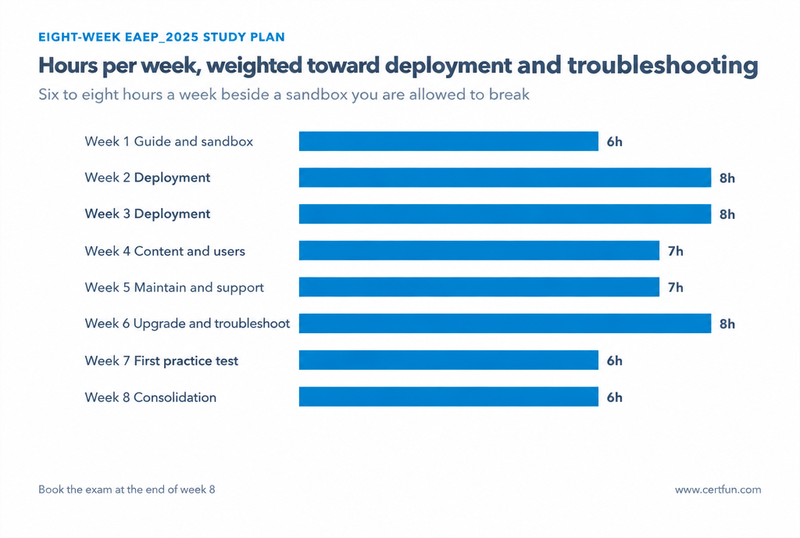
- Week 1, the Exam Information Guide and a sandbox. Read Esri's guide for this exam end to end and turn every skill statement into a line in a spreadsheet with a confidence score from one to five. Then build a single-machine base deployment on a virtual machine you are allowed to destroy. If you cannot license one at work, Esri's developer and trial offerings are the usual route.
- Weeks 2 and 3, deployment. Rebuild the base deployment, this time with Web Adaptors, HTTPS certificates you issued yourself and a federated hosting server. Add a second server site in a different role. Register every data store type you can and note what each is for. Change the portal organisation settings one at a time and watch what each one does for a member.
- Week 4, content and users. Create groups with different sharing patterns, assign member roles and licences, publish services referencing registered data and services copying data, and compare the two. Set up a collaboration between your sandbox portal and an ArcGIS Online organisation if you have access to one.
- Week 5, maintenance and support. Run the health check endpoints and read what they return. Take a full backup with the deployment backup tool, destroy the portal and restore it. Change pooling and shared-instance settings on a busy service and measure the memory and response time before and after.
- Week 6, upgrade and troubleshoot. Upgrade your sandbox one version, in the documented order, and record every pre-check and post-step. Then break it: revoke a certificate, stop the data store, unregister a data source under a live service, fill a disk. For each break, find the fault from the logs alone before you fix it.
- Week 7, the first full practice test. Sit a timed 75-question practice exam in one go, with no notes. Score every miss against your week 1 spreadsheet and spend the rest of the week only on the skills that scored lowest.
- Week 8, consolidation. A second and, if the first was below your comfort level, a third timed practice test, each followed by the same miss analysis. Book the real exam for the end of this week while the material is fresh.
If you are a full-time Enterprise administrator with the four years Esri expects, you can compress weeks 2 to 5 into two weeks and keep the rest. If you are coming from ArcGIS Online or from general IT, do not: the deployment and troubleshooting weeks are where your gaps are, and they are the two domains that together carry over half the questions.
How should you use an EAEP_2025 practice test before booking?
A practice test is a measuring instrument, not a textbook. Used too early it tells you only that you have not studied yet, and used as a study method it trains you to recognise answer patterns rather than to administer software. Used at the right moment it does three things no amount of reading can.
First, it calibrates your pace. Most candidates discover in the first timed sitting that scenario questions take them two to three minutes each, far more than the 84 seconds the clock allows on average, and that they must answer the shorter factual items quickly to buy that time back. Second, it exposes the domain where your confidence and your score disagree. Administrators regularly rate themselves a five on deployment and then lose points on data store selection or authorisation details they have not touched in years. Third, it rehearses the pass-or-fail pressure. With no scaled score to aim for, the temptation is to leave hard questions blank; a timed run teaches you to answer everything and flag the doubtful ones for the final minutes.
Choose a practice exam whose questions are scenario-based and weighted across the four domains the way the real paper is, and that explains the correct answer so that each miss points you back to a skill statement. The CertFun ArcGIS Enterprise Administration Professional practice test is built on the published 2025 outline and is timed to the same 105 minutes, which makes the pacing lesson realistic. Whatever you use, treat a score comfortably above the level you need, achieved twice in a row on different question sets, as the signal to book. One strong result can be luck; two is readiness.
Is the ArcGIS Enterprise Administration Professional 2025 certification worth it for your career?
For a working ArcGIS Enterprise administrator the answer is usually yes, for a reason that has little to do with learning anything new. The certification converts experience that is hard to describe in an interview into a credential that a hiring manager, a procurement evaluator or a partner-programme reviewer can tick. Esri partner organisations in particular value professional-level technical certifications on staff, and public-sector tenders for GIS services often ask for them by name.
For someone moving into the role from general infrastructure work, the preparation is worth more than the certificate. The syllabus is a well-ordered tour of everything an Enterprise administrator is responsible for, and following it on a sandbox for eight weeks is a faster way to competence than waiting for each problem to arrive in production. The certificate at the end is then evidence that the tour was completed.
Two honest caveats. Esri exams are versioned to a software release, and the 2025 designation means this credential will eventually be succeeded by a newer version as ArcGIS Enterprise moves on; check Esri's certification page for the current retirement and recertification rules before you invest. And the exam is pass or fail at 325 USD a sitting, with no partial credit and no score to show for a near miss, so the economics favour preparing properly once over sitting it early to see what happens.
Next step
Download the Exam Information Guide from Esri's exam page, score yourself against every skill statement, and start the sandbox this week. When you reach week 7 of the plan, sit a timed EAEP_2025 practice test and let the result, not the calendar, decide when you book.
Frequently Asked Questions
How much does the EAEP_2025 exam cost and how long does it take?
As of October 2026 the Esri exam voucher for EAEP_2025 costs 325 USD. The sitting lasts 105 minutes and contains 75 questions, delivered through Pearson VUE. The result is pass or fail with no numeric score, so a failed attempt gives you no partial credit and means buying a new voucher.
What are the four EAEP_2025 syllabus domains and their weights?
Deploy ArcGIS Enterprise carries 34 percent, Manage Content and Users in ArcGIS Enterprise 26 percent, Maintain and Support ArcGIS Enterprise 22 percent and Troubleshoot ArcGIS Enterprise 18 percent. Deployment and content management together make up 60 percent of the paper, so they deserve the largest share of study time.
How much experience does Esri expect before sitting EAEP_2025?
Esri states that the exam expects four years of experience applying the measured skills to support enterprise GIS workflows. There is no formal prerequisite exam or course, so you can book it without an associate certification, but the scenario-based questions assume you have deployed, upgraded and troubleshot ArcGIS Enterprise yourself.
Does Esri publish its own EAEP_2025 practice test?
Esri publishes an Exam Information Guide listing the skills measured and links a learning plan on its exam page, but the preparation material there is training rather than a full-length timed test. Third-party practice exams, including the one CertFun sells, fill that gap; none of them is official Esri material.
Which EAEP_2025 domain do most candidates find hardest?
Troubleshooting is the usual answer from experienced administrators, because the exam replaces the interactive look-and-adjust loop with a single snapshot and asks you to name the decisive log or setting. Candidates from ArcGIS Online administration more often struggle with deployment topics such as data store types and federation.
How long should I prepare for EAEP_2025?
An eight-week plan at six to eight hours a week suits most candidates who already work with ArcGIS Enterprise, with time split roughly in proportion to the domain weights. Full-time administrators with several years in the role can compress the deployment weeks; people arriving from general IT or ArcGIS Online should not.
- Esri Certified ArcGIS Enterprise Administration Professional 2025 |
- EAEP_2025 ArcGIS Enterprise Administration Professional |
- ArcGIS Enterprise Administration Professional Study Guide |
- ArcGIS Enterprise Administration Professional Certification Mock Test |
- Esri Enterprise Administration Professional Practice Test |
- ArcGIS Enterprise Administration Professional Certification Syllabus |
- Enterprise Administration Professional Certification Cost |
- Esri Enterprise Administration Professional Certification


