
Databricks Certification: Complete Guide to All Tracks, Exams, and Career Outcomes (2026)
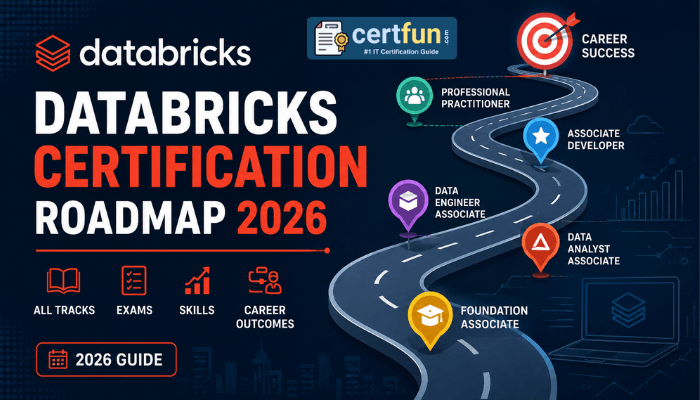
Databricks certifications validate hands-on expertise in the world's fastest-growing data and AI platform — and in 2026, that expertise is in serious demand. According to ZipRecruiter's March 2026 salary data, Databricks Data Engineers earn between $114,500 and $162,000 annually in the United States, with top earners exceeding $162K. The U.S. Bureau of Labor Statistics projects 34% growth in data engineering roles through 2034 — one of the fastest growth rates in any technical field.
Whether you are starting out in data engineering, pivoting into machine learning, or building expertise in generative AI, this guide covers every Databricks certification track — what each exam tests, what it costs, how to prepare, and what career outcomes you can expect.
What Is the Databricks Certification Program?
The Databricks Certification Program offers role-based, proctored exams that validate technical skills on the Databricks Data Intelligence Platform. All exams are delivered online or at authorized test centers, cost $200 USD per attempt, and are valid for two years before recertification is required.
Databricks organizes its credentials into three tiers:
- Free Fundamentals Badges — Entry-level, non-proctored, self-paced
- Role-Based Associate and Professional Certifications — Proctored, paid, industry-recognized
- Platform Architect Certifications — Advanced architecture credentials for cloud platforms
As of 2026, Databricks certifications are held by hundreds of thousands of practitioners globally, with certified professionals consistently reporting career advancement, promotions, and higher visibility in job markets according to Databricks' own professional impact research.
What Are All the Databricks Certifications Available in 2026?
| Certification | Level | Exam Code | Cost | Questions | Time |
|---|---|---|---|---|---|
| Data Engineer Associate | Associate | DEA | $200 | 45 | 90 min |
| Data Engineer Professional | Professional | DEP | $200 | 59 | 120 min |
| Machine Learning Associate | Associate | MLA | $200 | 48 | 90 min |
| Machine Learning Professional | Professional | MLP | $200 | 59 | 120 min |
| Generative AI Engineer Associate | Associate | GAIA | $200 | 45 | 90 min |
| Context Engineer Associate | Associate | CEA | $200 | 45 | 90 min |
| Data Analyst Associate | Associate | DAA | $200 | 45 | 90 min |
| Apache Spark Developer Associate | Associate | SDAP | $200 | 45 | 90 min |
| AWS Platform Architect | Architect | — | $200 | [VERIFY] | [VERIFY] |
| Azure Platform Architect | Architect | — | $200 | [VERIFY] | [VERIFY] |
| GCP Platform Architect | Architect | — | $200 | [VERIFY] | [VERIFY] |
All paid certifications are valid for 2 years and require retaking the current exam version to recertify. Exam delivery: online proctored or test center. No test aids allowed. Multiple-choice format.
What Are the Free Databricks Fundamentals Badges?
Databricks offers three free, self-paced training badges that serve as an on-ramp to the paid certification program. These are not proctored exams — they are completion-based credentials awarded after finishing on-demand training modules.
- Lakehouse Fundamentals — Introduces the Databricks Lakehouse architecture, Delta Lake, and core platform concepts. Ideal for anyone new to Databricks.
- Generative AI Fundamentals — Covers large language models, prompt engineering, and building GenAI applications on Databricks.
- AI Agent Fundamentals — Explores AI agent design, tool use, and autonomous systems on the Databricks platform.
These free badges are accessible through Databricks Training and are an excellent foundation before attempting any Associate-level exam.
What Is the Databricks Certified Data Engineer Associate Certification?
The Data Engineer Associate (DEA) is the most widely pursued Databricks certification and the recommended starting point for anyone working with data pipelines, Delta Lake, or Spark on Databricks.
Exam Details
According to the official Databricks Data Engineer Associate exam page:
- Cost: $200 USD
- Questions: 45 scored, multiple choice
- Time limit: 90 minutes
- Delivery: Online proctored or test center
- Languages: English, Japanese, Portuguese (BR), Korean
- Validity: 2 years (recertification required)
- Prerequisites: None required; hands-on experience recommended
What Does the Exam Test?
The DEA exam assesses six core knowledge areas on the Databricks platform:
- Databricks Intelligence Platform — Workspace architecture, cluster types, Databricks Runtime, Unity Catalog
- Data Ingestion and Loading — Auto Loader, COPY INTO, streaming ingestion with Delta Live Tables
- Data Transformation and Modeling — ETL with PySpark and SQL, Medallion Architecture, Delta Lake operations
- Productionizing Data Pipelines — Lakeflow Jobs, Delta Live Tables, CI/CD, workflow orchestration
- Monitoring, Troubleshooting and Optimization — Cluster tuning, query performance, job monitoring
- Data Governance and Security — Unity Catalog, data access controls, row-level and column-level security
May 2026 Exam Update
Databricks updated the DEA exam guide in May 2026 to increase emphasis on:
- Delta Live Tables (DLT) and declarative pipeline development
- Unity Catalog for data governance and discovery
- Delta Sharing for cross-platform data access
- Lakehouse Federation for querying external systems
- Databricks Asset Bundles (DAB) for CI/CD
- Scenario-based questions replacing simple recall questions
If you studied from materials published before May 2026, review the updated exam guide on the official Databricks certification page before sitting the exam.
Who Should Take the DEA?
The Data Engineer Associate is ideal for:
- Data engineers with 6+ months of hands-on Databricks experience
- Analytics engineers transitioning to Databricks-based pipelines
- Cloud engineers adding data platform skills to their profile
- Anyone preparing for the Data Engineer Professional exam
What Is the Databricks Certified Data Engineer Professional Certification?
The Data Engineer Professional (DEP) validates advanced production-grade data engineering skills on the Databricks platform. It is a natural progression from the Associate and is recognized as a senior-level credential.
Exam Details
According to the official Databricks Data Engineer Professional page:
- Cost: $200 USD
- Questions: 59 scored, multiple choice
- Time limit: 120 minutes
- Delivery: Online proctored or test center
- Validity: 2 years
Exam Domains and Weightings
| Domain | Weight |
|---|---|
| Developing Code for Data Processing (Python & SQL) | 22% |
| Cost & Performance Optimization | 13% |
| Data Transformation, Cleansing, and Quality | 10% |
| Monitoring and Alerting | 10% |
| Ensuring Data Security and Compliance | 10% |
| Debugging and Deploying | 10% |
| Data Governance | 7% |
| Data Ingestion & Acquisition | 7% |
| Data Modelling | 6% |
| Data Sharing and Federation | 5% |
Code development (Python/SQL) and performance optimization together account for 35% of the exam — making hands-on coding proficiency the most important preparation area.
Who Should Take the DEP?
This certification targets senior data engineers and technical leads who:
- Build and optimize production Databricks pipelines
- Manage data quality and governance at scale
- Work with Unity Catalog for enterprise data governance
- Need to demonstrate advanced Databricks expertise to employers
What Is the Databricks Certified Machine Learning Associate Certification?
The ML Associate validates the ability to perform foundational machine learning workflows using Databricks, MLflow, and Apache Spark MLlib.
Exam Details
According to the official Databricks ML Associate page:
- Cost: $200 USD
- Questions: 48 scored, multiple choice
- Time limit: 90 minutes
- Delivery: Online proctored or test center
- Recommended experience: 6+ months hands-on ML experience on Databricks
- Validity: 2 years
Exam Domains and Weightings
| Domain | Weight |
|---|---|
| Model Development | 31% |
| Databricks Machine Learning | 38% |
| ML Workflows | 19% |
| Model Deployment | 12% |
"Databricks Machine Learning" — covering MLflow experiment tracking, model registry, and AutoML — represents 38% of the exam, the largest single domain. Hands-on experience with MLflow is essential.
Who Should Take the ML Associate?
- Data scientists moving from local environments to cloud-scale ML on Databricks
- ML engineers integrating models into Databricks workflows
- Analysts expanding from SQL/BI into predictive modeling
- Anyone targeting the ML Professional certification as a next step
What Is the Databricks Generative AI Engineer Associate Certification?
The Generative AI Engineer Associate is Databricks' fastest-growing certification as organizations race to build production GenAI applications on lakehouse architectures. It validates skills in designing, building, and deploying GenAI solutions including RAG pipelines, LLM fine-tuning, and AI agent systems on Databricks.
According to Tredence's 2026 analysis of top GenAI certifications, GenAI-skilled data professionals are among the most in-demand technical hires globally in 2026.
Exam fee: $200 | Delivery: Online proctored | Validity: 2 years
Who Should Get the Databricks Data Analyst Associate Certification?
The Data Analyst Associate tests proficiency with Databricks SQL — the service that brings business intelligence and data analysis directly into the Databricks Lakehouse. This certification is targeted at analysts who work with Databricks SQL dashboards, queries, and data visualizations rather than Python-based engineering workflows.
It is the most accessible Databricks certification for analysts transitioning from traditional BI tools like Tableau or Power BI into a lakehouse environment.
What Is the Databricks Apache Spark Developer Associate Certification?
The Apache Spark Developer Associate validates understanding of the Spark DataFrame API for data processing at scale. Unlike the Data Engineer certifications — which test Databricks-specific features — this exam focuses on core Spark programming concepts applicable across any Spark environment.
It is valuable for engineers who work with Spark on AWS EMR, Azure HDInsight, Google Dataproc, or any platform where Databricks-specific features are not used.
How Much Do Databricks-Certified Professionals Earn in 2026?
What Do Certified Databricks Professionals Earn?
According to ZipRecruiter's 2026 Databricks Data Engineer salary data:
- 25th percentile: $114,500/year
- Median: $129,716/year
- 75th percentile: $137,500/year
- 90th percentile: $162,000/year
Glassdoor's 2026 figures report the average Databricks Data Engineer salary at $133,130/year, with a range of $104,368 to $171,580 for senior roles.
Professionals holding the Data Engineer Professional or ML Professional certifications command salaries at the higher end of these ranges, consistent with Databricks' research showing certified professionals earn 15–30% more than non-certified peers in equivalent roles.
Job Market Demand
Databricks skills appear in a significant share of data engineering job postings. According to DataCamp's 2026 Databricks certification guide, the platform has seen explosive adoption driven by the convergence of data engineering, ML, and generative AI on a unified lakehouse architecture.
The U.S. Bureau of Labor Statistics projects 34% growth in software/data engineering roles through 2034, with data engineers among the most in-demand specializations within that category.
Career Impact Beyond Salary
The Databricks Professional Impact research documents a consistent pattern across thousands of certified professionals: certification accelerates career trajectories in ways that extend well beyond the initial salary jump.
As DataCamp's 2026 Databricks certification analysis summarizes: "Certified Databricks professionals are not just better paid — they move faster through interviews, are trusted with higher-stakes projects sooner, and transition from individual contributors to technical leads more rapidly than their non-certified peers."
According to Databricks' own Professional Impact research, certified professionals report:
- Career advancement and promotions within 12 months of certification
- Increased LinkedIn visibility and recruiter engagement
- Greater confidence in technical interviews and client-facing work
- Recognition as subject-matter experts within their organizations
How to Choose the Right Databricks Certification Path
The right certification depends on your current role and career target.
| Your Role / Goal | Recommended Starting Point | Next Step |
|---|---|---|
| New to Databricks | Lakehouse Fundamentals badge (free) | Data Engineer Associate |
| Data Engineer | Data Engineer Associate | Data Engineer Professional |
| Data Scientist / ML Engineer | Machine Learning Associate | ML Professional |
| AI / GenAI Engineer | GenAI Engineer Associate | Context Engineer Associate |
| Business / Data Analyst | Data Analyst Associate | Data Engineer Associate |
| Cloud Architect | Any Associate | AWS/Azure/GCP Platform Architect |
| Spark Developer (non-Databricks) | Apache Spark Developer Associate | Data Engineer Associate |
Most candidates should start with the free Lakehouse Fundamentals badge, even if they have Databricks experience. It solidifies platform concepts before tackling proctored exams.
How to Prepare for Databricks Certification Exams
Step 1: Use Official Databricks Academy
Databricks Training offers the most current, exam-aligned learning content. Official learning paths are updated alongside exam guide revisions — critical given the May 2026 DEA update.
Step 2: Get Hands-On with a Databricks Account
Every Databricks exam is scenario-based and requires practical experience. A free Databricks Community Edition account lets you run notebooks, build pipelines, and work with Delta Lake at no cost.
Step 3: Study the Exam Guide Carefully
Download the official exam guide for your target certification from credentials.databricks.com. The exam guide lists exact domains, topics, and sample questions. For the DEA specifically, ensure you are using the May 2026 version of the guide — earlier versions are outdated.
Step 4: Practice with Realistic Exam Questions
CertFun offers a comprehensive Databricks Data Engineer Associate question bank with 270+ questions organized by domain, including scenario-based questions that mirror the May 2026 exam format. Practicing under timed conditions is essential given the 45-question, 90-minute format.
You can also review Databricks Data Engineer Associate sample questions to assess your current knowledge gaps before committing to full preparation.
Step 5: Set a Realistic Timeline
| Experience Level | Recommended Study Time |
|---|---|
| 6+ months Databricks hands-on | 3–4 weeks |
| 1–3 months Databricks hands-on | 6–8 weeks |
| New to Databricks | 10–12 weeks (includes free badge courses) |
How Does Databricks Certification Compare to AWS and Azure Data Certifications?
| Certification | Cost | Focus | Employer Demand | Salary Impact |
|---|---|---|---|---|
| Databricks Data Engineer Associate | $200 | Lakehouse, Delta Lake, Spark | High — lakehouse-native roles | 15–30% premium |
| AWS Certified Data Engineer Associate | $300 | AWS Glue, S3, Redshift, Kinesis | High — AWS-native pipelines | Comparable |
| Microsoft Azure Data Engineer DP-203 | $165 | Azure Data Factory, Synapse | High — Azure-native stacks | Comparable |
| Google Professional Data Engineer | $200 | BigQuery, Dataflow, Pub/Sub | High — GCP-native roles | Comparable |
Databricks is the only certification in this group that is cloud-agnostic — the same credential is valid whether you deploy on AWS, Azure, or GCP. This flexibility makes it increasingly attractive compared to cloud-vendor-specific data engineering certifications.
Flexera's 2026 enterprise cloud analysis notes: "Organizations running multi-cloud data infrastructure consistently cite Databricks certification as the most transferable technical credential for data engineering roles, precisely because it validates platform-agnostic lakehouse skills rather than a single vendor's managed service."
What Are the Best Tips for Passing Databricks Certification on the First Attempt?
- Know your Unity Catalog cold. Unity Catalog governance appears in the DEA Professional, ML, and GenAI exams. It accounts for a significant portion of governance-related questions across all tracks.
- Practice PySpark and SQL side by side. The Professional exam weights Python/SQL coding at 22% — the largest single domain.
- Understand the Medallion Architecture. Bronze → Silver → Gold data flow patterns appear across the DEA and DEP exams consistently.
- Memorize Delta Live Tables syntax. DLT pipeline development is a high-weight topic added in the May 2026 DEA update.
- Use Lakeflow Jobs hands-on. Scheduling, dependencies, retries, and alerts in Lakeflow Jobs are tested with scenario-based questions, not just definitions.
- Do not memorize answers. Databricks exams use scenario-based questions that require understanding, not recall. Exam dumps do not reflect the actual exam format.
Who Should NOT Get a Databricks Certification (Yet)?
A Databricks certification delivers its full ROI when you have real platform experience. Pursuing the DEA without any hands-on Databricks work will result in a difficult, expensive exam experience with low utility even if you pass.
Skip the certification if:
- You have never logged into Databricks
- Your organization uses only AWS Glue, dbt, or pure-SQL pipelines with no Databricks component
- You are preparing for a cloud-architect role and have not yet completed any Associate-level Databricks cert
Start with the free Lakehouse Fundamentals badge in all of these cases. It takes 2–3 hours, costs nothing, and will tell you quickly whether Databricks is the right platform to build expertise in.
Frequently Asked Questions About Databricks Certification
Q: How much does the Databricks certification exam cost?
A: All paid Databricks certification exams cost $200 USD per attempt. This price applies to all Associate, Professional, and Platform Architect credentials. Free Fundamentals badges (Lakehouse, GenAI, AI Agent) require no payment.
Q: How many questions are on the Databricks Data Engineer Associate exam?
A: The Data Engineer Associate exam contains 45 scored multiple-choice questions, delivered in a 90-minute window. The Data Engineer Professional contains 59 questions in 120 minutes.
Q: How long is a Databricks certification valid?
A: All paid Databricks certifications are valid for 2 years. Recertification requires retaking the current version of the exam — there is no alternative renewal pathway.
Q: Do I need prerequisites to take a Databricks certification?
A: No formal prerequisites are required for any Databricks certification. However, Databricks strongly recommends hands-on experience before attempting proctored exams. For the ML Associate, 6+ months of machine learning experience on Databricks is recommended.
Q: What is the passing score for Databricks certification exams?
A: Databricks does not publicly publish passing score thresholds. Exam results are reported as pass or fail immediately after completion.
Q: Which Databricks certification should I get first?
A: Most candidates should start with the free Lakehouse Fundamentals badge, then pursue the Data Engineer Associate (DEA). The DEA is the most widely recognized Databricks credential and is required context for all other tracks. If your role is purely analytics, the Data Analyst Associate is the better first step.
Q: Is the Databricks certification worth getting in 2026?
A: Yes — for professionals working on Databricks-based pipelines, the certification is one of the highest-ROI technical investments available. Data engineers with Databricks certification earn between $129,000 and $162,000 annually, and the platform appears in a growing share of data engineering job postings as organizations adopt lakehouse architectures.
Q: Can I take the Databricks exam online?
A: Yes. All Databricks certification exams are available via online proctoring or at an authorized test center. Online proctoring requires a webcam, stable internet connection, and a distraction-free environment.
Q: What changed in the May 2026 Databricks DEA exam update?
A: The May 2026 update increased emphasis on Delta Live Tables (DLT), Unity Catalog governance, Delta Sharing, Lakehouse Federation, Databricks Asset Bundles (DAB), and scenario-based questions. Candidates should ensure they use the updated exam guide from credentials.databricks.com rather than pre-2026 study materials.
Q: How does Databricks certification compare to AWS or Azure data certifications?
A: Databricks certification is cloud-agnostic — valid across AWS, Azure, and GCP deployments. AWS, Azure, and GCP data certifications are specific to each vendor's managed services. If you work in a multi-cloud or Databricks-first organization, the Databricks credential offers broader applicability. Salary outcomes are comparable across all four credentials.
Q: How do I register for a Databricks certification exam?
A: Exams are registered through credentials.databricks.com using your Databricks account. You can select online proctoring or a test center location during the registration process.
Q: What resources does Databricks provide for exam preparation?
A: Databricks provides official learning paths through Databricks Training, exam guides at credentials.databricks.com, and community forums. For additional practice questions and mock exams, CertFun's Databricks practice tests provide scenario-based preparation aligned with the current exam format.
Ready to Earn Your Databricks Certification?
Databricks skills are among the most valuable in the data engineering market in 2026 — and certification is the fastest way to validate yours to employers. Whether you are targeting the Data Engineer Associate to break into lakehouse engineering, or the ML Professional to advance your machine learning career, CertFun's Databricks certified preparation resources give you the practice environment you need to pass on your first attempt.
Practice with CertFun's realistic mock exams and pass your IT certification on the first try. Explore Databricks practice tests on CertFun →


