
HPE ASE-StorArc Mastery: Beyond the Study Guide

The HPE ASE - Storage Architect certification, validated by the HPE0-J82 exam, signifies a professional's advanced capability in designing and implementing complex HPE storage solutions. This credential is engineered for architects and senior technical professionals who aim to demonstrate expertise across HPE's diverse storage portfolio, including Alletra, Primera, Nimble, and GreenLake. Earning this certification confirms a profound understanding of storage architectures, solution integration, and best practices tailored to client needs. This comprehensive guide delves into the core objectives, preparation strategies, and career implications of achieving HPE ASE-StorArc mastery, moving beyond basic study materials to offer a holistic readiness perspective.
Assessing the HPE0-J82 Exam Framework
Preparing for the HPE0-J82 assessment requires a clear understanding of its structure and parameters. This examination is designed to rigorously test a candidate's practical and theoretical knowledge in architecting storage solutions for Hewlett Packard Enterprise. Successful completion affirms a candidate's ability to navigate and apply HPE's sophisticated storage ecosystem effectively.
The key details for the HPE ASE - Storage Architect (HPE0-J82) exam are:
-
Exam Name: HPE ASE - Storage Architect
-
Exam Code: HPE0-J82
-
Duration: 90 minutes
-
Number of Questions: 60 multiple-choice and scenario-based questions
-
Passing Score: Candidates must achieve 63% to pass
-
Exam Price: Developed Countries: 260 USD
-
Emerging Countries: 145 USD
Understanding these specifics is the first step toward a strategic preparation plan. For complete details and official documentation, refer to the official exam blueprint directly from HPE.
Deconstructing the HPE ASE-StorArc Syllabus Domains
The HPE ASE - Storage Architect (HPE0-J82) exam syllabus is meticulously structured to cover a wide spectrum of critical storage architecture knowledge and skills. Each domain carries a specific weight, indicating the depth of focus required during preparation. A strategic approach to studying involves allocating time proportionate to these percentages, ensuring comprehensive coverage of high-impact areas.
Foundational Storage Architectures and Technologies (15%)
This segment mandates the ability to differentiate and apply core storage concepts. It involves understanding various storage protocols, data protection schemes, and fundamental components that underpin modern data centers. Mastery here means recognizing the right architectural choices for different workloads and performance requirements. Candidates should be adept at discussing concepts like SAN, NAS, object storage, and their respective use cases.
HPE Storage Architectures and Technologies (33%)
This is the largest segment, demanding extensive knowledge of HPE's proprietary storage solutions. It covers the specifics of HPE's product lines, their unique features, and how they integrate into broader IT infrastructures. Professionals must grasp the intricacies of HPE Alletra, Primera, Nimble Storage, and GreenLake for Storage, articulating their value propositions and technical specifications. Understanding these solutions is vital for passing the HPE0-J82 exam and applying the certification in real-world scenarios.
HPE Storage Solutions Strengths (2%)
Though a smaller percentage, this domain focuses on identifying the distinct advantages and competitive differentiators of HPE storage offerings. It requires candidates to understand why an HPE solution might be preferable over alternatives, often involving performance, scalability, management, or cost-efficiency comparisons. This showcases the ability to advocate for HPE solutions based on their inherent strengths.
Customer Environment Evaluation (40%)
Another high-weight domain, this emphasizes the critical skill of assessing a customer's existing environment. This involves analyzing current infrastructure, identifying pain points, evaluating performance bottlenecks, and understanding future growth projections. A significant part of this involves data gathering, requirements analysis, and discerning the technical and business needs that drive storage decisions. This practical application of knowledge is paramount for any storage architect.
Identifying Customer Opportunities (10%)
Following environment evaluation, this domain assesses the ability to translate identified needs into tangible opportunities for HPE storage solutions. It involves proposing appropriate architectures, validating solution designs against requirements, and articulating the benefits in terms of business value and technical improvement. This requires a blend of technical acumen and consultative skills to align HPE's capabilities with client strategic goals.
Architecting with HPE Storage: Design Principles and Best Practices
Designing robust, scalable, and efficient storage solutions is a cornerstone of the HPE ASE-StorArc role. This involves more than just selecting products; it requires a deep understanding of how different components interact and how to optimize them for diverse workloads. Adhering to HPE storage design best practices ensures solutions are not only functional but also resilient, secure, and cost-effective over their lifecycle.
Foundational Design Considerations
Effective storage architecture begins with fundamental principles that transcend specific products. A thorough understanding of these concepts enables architects to build versatile and adaptable systems.
-
Performance Requirements: Identifying IOPS, bandwidth, and latency needs for various applications and data types. This involves workload characterization and tiering strategies.
-
Scalability and Growth: Designing for future expansion, both horizontally and vertically, to accommodate increasing data volumes and user demands without disruption.
-
Data Protection and Recovery: Implementing robust backup, replication, and disaster recovery strategies, including snapshots, mirroring, and remote replication, to meet RPO and RTO objectives.
-
Security and Compliance: Ensuring data confidentiality, integrity, and availability through access controls, encryption, and adherence to industry regulations.
-
Cost Optimization: Balancing performance and capacity needs with budget constraints, leveraging features like data reduction (deduplication, compression) and efficient resource utilization.
HPE Storage Solutions Architecture Design
HPE offers a rich portfolio of storage solutions, each with specific strengths. Designing with these solutions requires matching their capabilities to the unique demands of a customer's environment. The HPE ASE - Storage Architect role involves intricate knowledge of how to integrate these solutions into existing infrastructures.
Consideration of specific HPE platforms is paramount for crafting tailored solutions:
-
HPE Alletra Storage: Focus on its cloud-native architecture, AIOps capabilities, and seamless integration for demanding workloads. Design considerations involve leveraging its intelligence for autonomous operations and optimized performance.
-
HPE Primera Storage: Emphasizes mission-critical applications requiring extreme resilience and consistent performance. Design must factor in its all-active architecture and guaranteed 100% availability.
-
HPE Nimble Storage: Known for its predictive flash storage, design focuses on using its InfoSight AI for proactive problem resolution and optimized resource allocation, particularly for mixed workloads and virtualized environments.
-
HPE GreenLake for Storage: Solutions architecting involves understanding its as-a-service model, enabling flexible consumption and on-demand scalability for various storage needs. Designing within GreenLake's framework means aligning cost with actual usage and simplifying procurement.
Each of these platforms, while distinct, can be combined or selected to form a cohesive HPE certification framework for a comprehensive data strategy.
Deeper Exploration of HPE Storage Technologies
The landscape of enterprise storage is constantly evolving, with HPE at the forefront of innovation. The HPE ASE - Storage Architect certification emphasizes a detailed understanding of the vendor's diverse product lines and their application in real-world scenarios. This section expands on the critical components and strategic value of HPE's flagship storage platforms.
HPE Alletra Storage Architect Certification Insights
HPE Alletra represents a paradigm shift towards cloud-native data infrastructure. Architects aspiring for the HPE ASE-StorArc certification must grasp Alletra's core tenets: a unified cloud experience, AI-driven operations, and guaranteed performance. Design for Alletra involves leveraging its ability to simplify management, predict and prevent disruptions, and deliver consistent service levels for demanding applications. Understanding its differentiation from traditional storage arrays is crucial.
HPE GreenLake for Storage Solutions Architect Perspectives
HPE GreenLake transforms IT into a flexible, consumption-based model. For a solutions architect, this means designing storage services that align with business outcomes, offering cloud agility with on-premises control. Expertise here involves mapping customer capacity, performance, and data protection needs to GreenLake's various service offerings (e.g., Block Storage, File Storage, Data Services Cloud Console). This requires a shift from traditional CAPEX to an OPEX mindset in solution design.
HPE Primera Storage Architect Exam Relevance
The HPE Primera storage architect exam objectives emphasize unwavering availability and performance for mission-critical workloads. Candidates must be proficient in architecting solutions that capitalize on Primera's all-active design, multi-node architecture, and guaranteed 100% data availability. This involves understanding its data services, replication capabilities, and seamless integration with existing HPE ecosystems to ensure business continuity and operational excellence.
HPE Nimble Storage Architect Expertise
HPE Nimble Storage stands out for its predictive analytics, powered by HPE InfoSight. Demonstrating HPE Nimble storage architect expertise requires the ability to design solutions that leverage InfoSight's global intelligence for proactive issue resolution, performance optimization, and capacity planning. This applies across hybrid flash and all-flash arrays, catering to a wide range of applications from virtualized environments to database acceleration. The value of InfoSight in reducing support calls and optimizing infrastructure cannot be overstated.
Evaluating Customer Environments and Identifying Opportunities
A critical function of a storage architect is the meticulous evaluation of a customer’s existing data infrastructure and operational environment. This high-weighted domain (40%) in the HPE0-J82 exam underscores the importance of a systematic approach to understanding current challenges and future requirements. Beyond technical assessment, it’s about aligning proposed solutions with business objectives, identifying opportunities, and crafting compelling value propositions.
Comprehensive Environmental Assessment
Effective evaluation begins with a holistic view of the customer's IT landscape. This involves gathering detailed information about their applications, data types, current storage solutions, networking, server infrastructure, and virtualization platforms.
-
Application Workload Profiling: Analyzing specific application demands regarding IOPS, throughput, latency, and capacity. Understanding critical business applications and their dependencies is paramount.
-
Current Storage Inventory: Documenting existing storage arrays, their capacities, utilization rates, performance metrics, and end-of-life status. Identifying underutilized or overprovisioned resources.
-
Network and Server Infrastructure: Assessing the performance and scalability of the SAN, NAS, and IP networks, along with the server estate (physical and virtual) that consumes storage.
-
Data Protection Strategy: Reviewing existing backup, disaster recovery, and business continuity plans. Identifying gaps, RPO/RTO objectives, and compliance requirements.
-
Operational Challenges: Understanding administrative overhead, management complexity, staffing levels, and any recurring performance or availability issues.
-
Business Objectives and Growth Plans: Engaging with stakeholders to understand strategic initiatives, budget cycles, and anticipated data growth or new application deployments.
Translating Needs into HPE Opportunities
Once the environment is thoroughly assessed, the architect must identify clear opportunities where HPE storage solutions can provide significant value. This process (10% of the syllabus) involves connecting identified pain points and future needs with specific HPE offerings.
Key areas for identifying opportunities include:
-
Performance Bottlenecks: Proposing HPE all-flash arrays like Alletra or Primera to address latency-sensitive applications or VDI environments.
-
Scalability Issues: Recommending flexible, scalable platforms like GreenLake for Storage or modular Nimble arrays to accommodate rapid data growth.
-
Data Protection Gaps: Designing comprehensive data protection strategies leveraging HPE StoreOnce, RMC (Recovery Manager Central), or native array replication capabilities.
-
Operational Complexity: Introducing AIOps-driven solutions like Alletra and InfoSight for Nimble to automate management and provide predictive analytics, reducing manual effort.
-
Cost Efficiency: Demonstrating how HPE solutions, through data reduction technologies or a consumption-based GreenLake model, can lower total cost of ownership.
-
Modernization Initiatives: Positioning HPE's cloud-native storage offerings as foundational for hybrid cloud strategies or digital transformation projects.
This phase is where the architect bridges the gap between technical assessment and strategic business enablement. Engaging with the HPE community forums can also provide valuable insights into common challenges and innovative solutions.
Strategic Implementation: Optimizing HPE Storage Environments
Beyond the design phase, an HPE ASE - Storage Architect is instrumental in ensuring that proposed solutions are implemented effectively and optimized for peak performance and efficiency. This involves meticulous planning, careful execution, and continuous monitoring to derive maximum value from the investment. The goal is to transform conceptual designs into tangible, high-performing storage infrastructures.
Deployment Planning and Execution
Successful implementation hinges on a well-defined plan that addresses all aspects of the deployment, from physical installation to logical configuration and data migration.
-
Solution Staging: Preparing the environment for new HPE storage systems, including rack space, power, networking, and necessary firmware updates.
-
Configuration and Integration: Configuring the HPE storage arrays (Alletra, Primera, Nimble, etc.) according to the validated design, integrating them with existing server, network, and virtualization platforms. This includes setting up SAN zoning, LUN provisioning, and file shares.
-
Data Migration Strategies: Planning and executing data migration from legacy systems to new HPE storage, considering methods like host-based, array-based, or network-based migration, minimizing downtime and ensuring data integrity.
-
Testing and Validation: Thoroughly testing the deployed solution to ensure it meets performance, availability, and functionality requirements as specified in the design.
Performance Tuning and Optimization
Even after successful deployment, ongoing optimization is crucial to maintain optimal performance and efficiency as workloads evolve. An architect's expertise in fine-tuning HPE storage environments significantly enhances operational excellence.
Key optimization areas include:
-
Workload Balancing: Distributing IO across multiple controllers, drives, and arrays to prevent hot spots and ensure consistent performance for all applications.
-
Data Tiering and Placement: Strategically placing data on the appropriate storage tiers (e.g., all-flash for critical, high-performance data; hybrid for balanced workloads) to optimize cost and performance.
-
Data Reduction Techniques: Leveraging HPE’s built-in deduplication, compression, and thin provisioning features to maximize storage efficiency and reduce physical capacity requirements.
-
Firmware and Software Updates: Regularly reviewing and applying necessary updates to HPE storage systems to benefit from new features, performance enhancements, and security patches.
Achieving these optimization goals often requires detailed analysis and a deep understanding of authorized HPE training principles.
Charting Your Course: The HPE Storage Architect Career Path
Earning the HPE ASE - Storage Architect certification opens doors to significant career advancement and specialized roles within the IT industry. This credential, built upon a strong foundation of technical expertise and strategic thinking, positions professionals as indispensable assets in organizations grappling with complex data challenges. The HPE storage architect salary potential often reflects this high level of specialized skill and responsibility.
Professional Growth and Role Impact
An HPE ASE - Storage Architect is typically a senior role, involving responsibilities that span the entire lifecycle of storage solutions. This includes pre-sales consulting, detailed solution design, implementation oversight, and ongoing optimization. Professionals with this certification are critical in:
-
Leading Storage Projects: Managing complex storage infrastructure initiatives from conception to deployment.
-
Strategic Planning: Contributing to the overall data strategy of an organization, aligning storage capabilities with business objectives.
-
Mentorship and Training: Guiding junior engineers and technical staff on HPE storage technologies and best practices.
-
Vendor Relationship Management: Acting as a key point of contact with HPE, influencing product roadmaps, and leveraging vendor resources effectively.
The impact on an organization is profound, ensuring that data—a critical business asset—is managed efficiently, securely, and cost-effectively.
The HPE Data Storage Certification Roadmap
The HPE ASE - Storage Architect is part of a broader HPE data storage certification roadmap. This roadmap provides a structured path for professionals to continually enhance their skills and validate expertise across various HPE technologies. The ASE level typically follows Associate (HPE ASC) and Professional (HPE ATP) certifications, signifying a deep, advanced understanding. Future progression might involve higher-level expert certifications or specializations in specific HPE solution areas, solidifying a continuous learning journey and further boosting an HPE storage architect salary.
Navigating the HPE0-J82 Exam: Preparation Strategies for Success
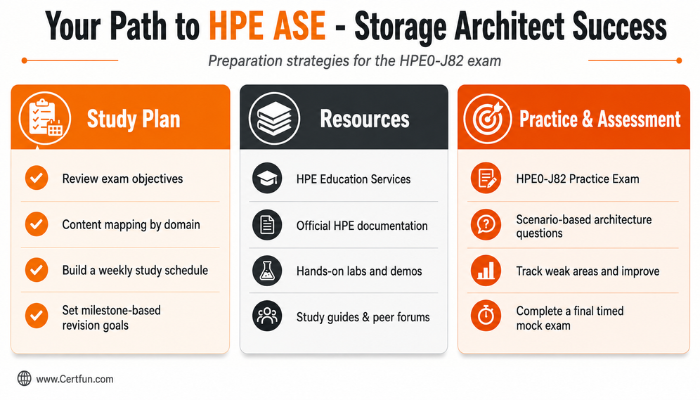
Success on the HPE0-J82 exam, HPE ASE - Storage Architect, demands more than just casual study; it requires a disciplined, multi-faceted preparation strategy. Given the technical depth and practical application focus of the exam, candidates must immerse themselves in both theoretical knowledge and real-world design scenarios. This section outlines key approaches to optimize your study efforts and increase your chances of mastering the HPE ASE-StorArc certification.
Building a Comprehensive Study Plan
A structured study plan is the backbone of effective exam preparation. Start by reviewing the official HPE ASE - Storage Architect syllabus and weighting for each domain to prioritize your focus.
-
Content Mapping: Align each syllabus objective with specific HPE documentation, whitepapers, product manuals, and training materials.
-
Time Management: Allocate dedicated study blocks, spreading out your preparation over several weeks or months to allow for retention and practical application.
-
Hands-on Experience: Whenever possible, gain practical experience with HPE storage systems. Lab environments, simulations, or even demo systems can significantly deepen your understanding.
Utilizing Official and Recommended Resources
Leveraging the right resources is crucial. HPE provides a wealth of information that directly correlates with the exam objectives.
-
HPE Documentation: Dive into the technical manuals, implementation guides, and best practice documents for HPE Alletra, Primera, Nimble Storage, and GreenLake for Storage.
-
HPE Education Services: Consider official HPE storage architect training courses, which are designed to provide in-depth knowledge and hands-on labs directly from the vendor. These courses are often tailored to certification objectives.
-
Community and Forums: Engage with the HPE community. Forums and discussion groups can be invaluable for clarifying concepts, understanding common challenges, and sharing insights.
Effective Practice and Self-Assessment
Regular self-assessment helps identify knowledge gaps and familiarizes you with the exam format. The "how to pass HPE0-J82 exam" question is often answered by consistent practice.
-
HPE0-J82 Practice Exam: Taking practice exams is vital. They simulate the actual exam environment, helping you manage time and understand the question styles. Focus on reviewing incorrect answers thoroughly to grasp underlying concepts.
-
HPE0-J82 Exam Questions: Familiarize yourself with the types of questions asked. These often involve scenario-based problems requiring you to apply your knowledge to solve real-world design or troubleshooting challenges.
-
Flashcards and Notes: Create your own flashcards for key terms, definitions, product differentiators, and architectural concepts. Summarizing complex topics in your own words reinforces learning.
It's important to approach HPE0-J82 practice exam questions as a learning tool, not just a measure of your current knowledge. For a good starting point, explore HPE0-J82 sample exam questions to gauge your readiness.
Avoiding Pitfalls and Ethical Preparation
In your pursuit of HPE ASE-StorArc mastery, always prioritize ethical and thorough preparation. Reliance on unauthorized "exam dumps" or memory-based questions undermines the value of your certification and compromises your true understanding of the material. Focus on building genuine expertise; this certification is designed to validate real-world skills, not just rote memorization. A commitment to ethical learning ensures you not only pass the exam but also excel as a proficient HPE Storage Architect.
Conclusion
Achieving HPE ASE-StorArc mastery through the HPE0-J82 exam is a significant accomplishment for any storage professional. It validates a deep, practical understanding of HPE's advanced storage solutions, from foundational architectures to strategic implementation and optimization. This certification distinguishes experts capable of designing and managing complex, high-performance, and resilient data infrastructures that drive business success. By committing to a structured study plan, leveraging official resources, and engaging in ethical practice, candidates can confidently navigate the exam and unlock substantial career opportunities.
Embarking on this certification journey is an investment in your professional future, equipping you with the advanced skills demanded by today's data-intensive world. Elevate your expertise and contribute to cutting-edge storage solutions. To continue your learning and explore other certifications, visit the full HPE certification portfolio to further your professional development.
FAQs
1. What skills does the HPE ASE - Storage Architect certification validate?
The HPE ASE - Storage Architect certification (HPE0-J82) validates a professional's ability to differentiate, design, and implement complex HPE storage solutions. This includes foundational storage architectures, detailed knowledge of HPE's product portfolio (Alletra, Primera, Nimble, GreenLake), and expertise in evaluating customer environments and identifying strategic opportunities for HPE solutions.
2. Who should pursue the HPE ASE - Storage Architect certification?
This certification is ideally suited for experienced storage administrators, solution architects, and senior technical consultants who specialize in designing and managing data storage solutions within Hewlett Packard Enterprise environments. It benefits professionals aiming to validate their advanced skills in HPE storage technology and strategy.
3. What are the prerequisites for the HPE0-J82 exam?
While HPE does not explicitly list formal prerequisites in all cases, candidates typically hold an HPE ATP or equivalent professional-level certification in a related storage domain, along with significant practical experience (3-5 years) in designing and implementing complex storage solutions. Prior experience with HPE storage products is highly recommended.
4. How long is the HPE ASE - Storage Architect certification valid?
HPE certifications typically have a validity period of two years. To maintain the certification, professionals usually need to pass a recertification exam or achieve a higher-level certification within the designated timeframe. Always check the official HPE certification program guide for the most current policy.
5. What kind of career impact can I expect from this certification?
Earning the HPE ASE - Storage Architect certification can significantly enhance career prospects, leading to roles such as Lead Storage Architect, Senior Storage Consultant, or Solution Designer. It often translates into higher earning potential and greater responsibility in designing and managing critical data infrastructure, establishing you as a trusted expert in HPE storage technologies.
- HPE Certification |
- HPE Storage Certification |
- HPE ASE - Storage Architect |
- HPE0-J82 Storage Architect |
- HPE0-J82 Online Test |
- HPE0-J82 Questions |
- HPE0-J82 Quiz |
- HPE0-J82 |
- HPE Storage Architect Certification |
- Storage Architect Practice Test |
- Storage Architect Study Guide |
- Hewlett Packard Enterprise HPE0-J82 Question Bank |
- Storage Architect Certification Mock Test |
- ASE-StorArc Simulator |
- ASE-StorArc Mock Exam |
- HPE ASE-StorArc Questions |
- ASE-StorArc |
- HPE ASE-StorArc Practice Test |
- HPE0-J82 Syllabus |
- Storage Architect Books |
- Storage Architect Certification Syllabus |
- Hewlett Packard Enterprise HPE0-J82 Books |
- HPE Storage Architect Training |
- ASE-StorArc Certification Cost |
- HPE ASE-StorArc Books |
- HPE ASE-StorArc Certification |
- Storage Architect Sample Questions |
- Hewlett Packard Enterprise HPE0-J82 Practice Test Free |
- ASE-StorArc Certification Sample Questions


