
ACA-915 Atlassian Cloud Fundamentals Exam: Topic Weights, Practice Test and a Two-Week Plan
ACA-915 is the exam for the Atlassian Certified Associate - Atlassian Cloud Fundamentals (ACA-ACF) credential. As of November 2026 it is free, non-proctored and online: 20 questions in 45 minutes, and you pass with 14 correct. It checks that you understand the Atlassian Cloud platform as a whole, not that you can administer one app. Before booking, run a timed ACA-915 practice test to see which of the three topics needs work.
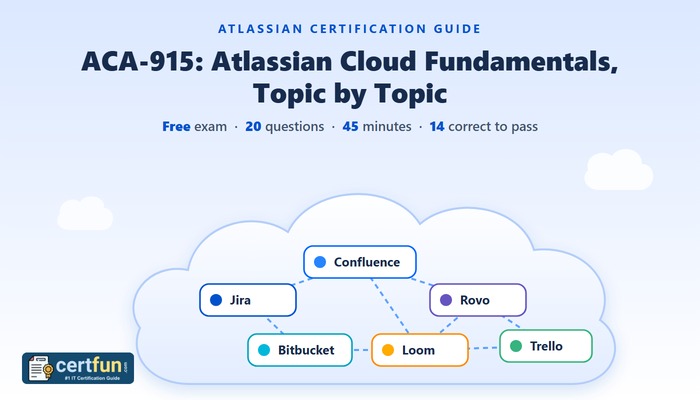
That combination of a free exam and a short paper fools many candidates. Twenty questions leave very little room: seven wrong answers and the attempt is over. Most mistakes on this exam come from people who use Jira or Confluence every day and assume that daily use covers the whole platform. It does not. The exam asks which app suits which team, how the apps connect, how a Cloud subscription and its users are managed, and where to go for help. This guide walks through each of those areas, shows how the marks are spread, and ends with a short plan you can finish in two weeks of evenings.
What does the ACA-915 Atlassian Cloud Fundamentals exam cover?
The ACA-915 exam covers the breadth of Atlassian Cloud rather than the depth of any single app. Atlassian describes it as an exam for current and future Cloud users who want to prove they know the essentials of Atlassian Cloud apps, the platform and the ecosystem around it. On its Atlassian Cloud Fundamentals certification page Atlassian lists what a certified person knows:
- which apps are included in the Atlassian Cloud platform;
- how Cloud apps support software, strategy and service teams;
- the key integrations between apps;
- the subscription model and the tiers for Cloud apps;
- how Cloud user management works;
- the basics of security for Cloud apps;
- how to navigate the Atlassian Cloud Community and support;
- how Rovo supports collaborative AI workflows.
The same page is just as clear about what is not tested: detailed app knowledge, migrations, implementations, and the differences between Cloud and Data Center. That exclusion list is useful when you plan your study. You do not need to memorize every Jira workflow setting, you do not need to know how a server instance is moved to Cloud, and you can skip comparison tables between deployment options. Time spent there is time taken away from the topics that carry the marks.
Atlassian names three audiences for the credential: new and current users of Atlassian Cloud solutions, people who need Cloud solutions, and Atlassian partners who provide solutions or training to Cloud customers. In practice that means project managers, team leads, support agents, new administrators, consultants at partner firms and anyone moving into a role where Atlassian tools are the daily workspace. It is an associate-level certificate, so there are no prerequisites listed and no years of experience required.
ACA-915 at a glance: price, time, questions and pass mark
| Item | Detail |
|---|---|
| Credential | Atlassian Certified Associate - Atlassian Cloud Fundamentals (ACA-ACF) |
| Exam code | ACA-915 |
| Price | Free (Atlassian's page, as of November 2026) |
| Questions | 20 |
| Time | 45 minutes |
| Passing score | 14 correct out of 20 |
| Delivery | Online, non-proctored |
| Valid for | 12 months; renew by retaking the free exam |
Forty-five minutes for 20 questions gives you a little over two minutes per question, which is generous for an associate exam. Time is rarely the problem. The pass mark is. Fourteen correct out of 20 is a 70 percent threshold, and because the paper is so short, every question is worth five percent of your score. Two careless answers on the topic you thought was easy can decide the result.
You schedule the exam through Atlassian's certification portal, which is run on Certmetrics. Because it is non-proctored, there is no test center and no webcam check, but you should still sit it in one quiet session: the clock does not stop because a colleague needs you. Atlassian's page does not publish a retake policy or a score-report format, so check both in the portal before you start rather than relying on forum posts.
The 12-month validity matters more than it first seems. Atlassian certificates are valid for a year, and the renewal is simply the same free exam taken again. Atlassian Cloud changes quickly, with new apps, renamed features and AI capabilities added through the year, so the renewal exam is unlikely to look exactly like your first one. Treat the renewal as a short refresh of what has changed, not as a repeat.
How are the three ACA-915 topics weighted?
Atlassian splits the exam into three topics. Atlassian Cloud apps and integrations carries 68 percent, Atlassian Cloud subscriptions and user management carries 15 percent, and Atlassian Cloud Community and support carries 17 percent. On a 20-question paper, if the questions follow the weights, that is roughly 14 of the 20 on apps and integrations, 3 on subscriptions and users, and 3 on Community and support.
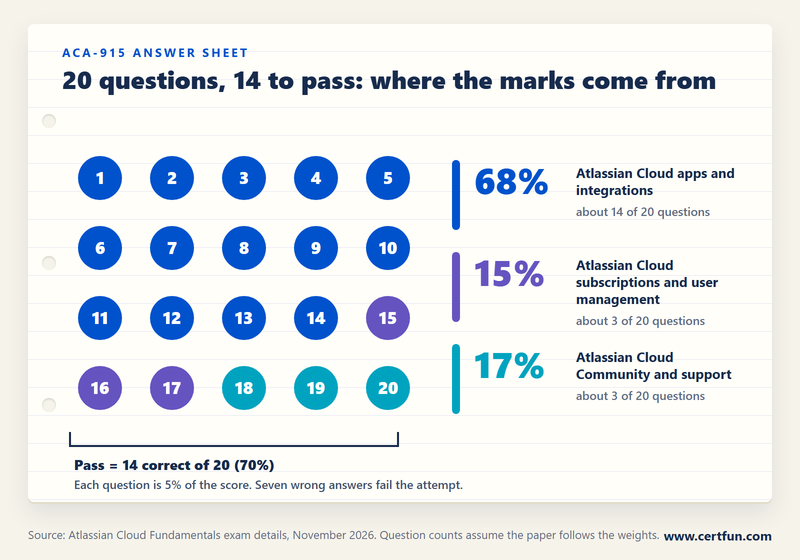
The arithmetic gives you a clear strategy. The apps and integrations topic is large enough that strong performance there can almost carry the pass mark by itself: a share of 14 is exactly the number of correct answers you need. That is also why it is risky to neglect the two smaller topics. If you drop four questions on apps, you need at least four of the remaining six, and those six come from the areas most daily users have never looked at.
A sensible split of study time is therefore not 68, 15 and 17. Most candidates already know two or three apps well, so the gap is usually in the apps they do not use, in the admin side of subscriptions, and in the support ecosystem. A practical starting split is about half of your time on apps and integrations and a quarter each on the two smaller topics, then adjust after your first timed practice run shows where you actually lose marks.
Which Atlassian Cloud apps and integrations must you know for ACA-915?
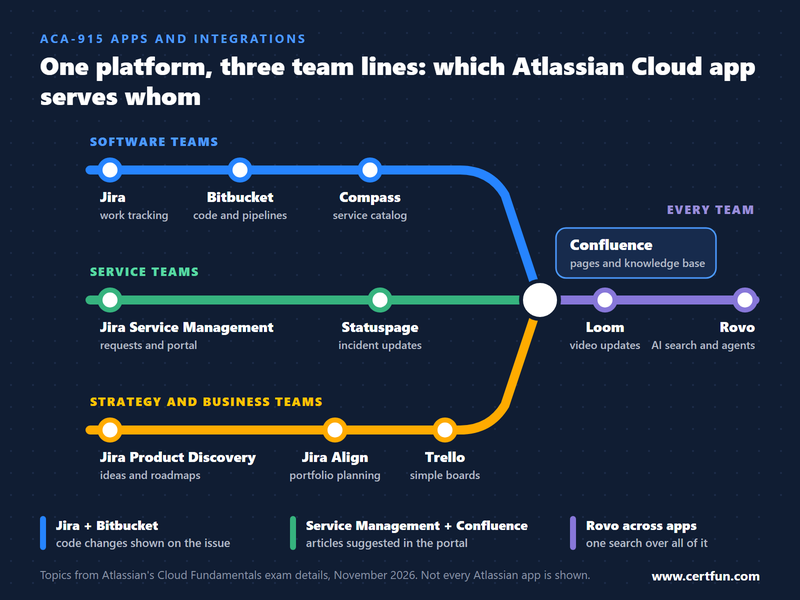
For ACA-915 you must know what each major Atlassian Cloud app is for, which kind of team uses it, and how the apps hand work to one another. Atlassian frames the platform around software teams, service teams and strategy teams, with a set of apps that every team shares. The questions in this topic are mostly about matching a need to an app and recognizing which integration solves a problem.
Software teams
Jira is the work-tracking app at the center of the platform: issues, boards, backlogs, sprints and workflows that move work from to-do to done. Software teams pair it with Bitbucket for Git code hosting and pipelines, so commits, branches and pull requests can appear on the Jira issue they relate to. Compass is the developer portal that catalogs the components and services a software organization runs, with their owners and health. The exam does not ask how to configure a pipeline. It asks you to recognize that a team wanting to see code changes next to the issue needs the Jira and Bitbucket link, or that a company losing track of who owns which service is describing what Compass does.
Service teams
Jira Service Management is the app for IT, HR, facilities and other teams that take requests from employees or customers. It adds a portal, queues, service-level agreements and request types on top of Jira. Its knowledge base is usually a Confluence space, so an answer written once can deflect the next ten tickets. Statuspage publishes the health of a service to its users during an incident. A typical question describes a team drowning in repeated emails and asks which combination of apps turns that into a portal with self-service articles.
Strategy and business teams
Business and product teams plan before they build. Jira Product Discovery collects ideas, scores them and turns the chosen ones into a roadmap that links to delivery work in Jira. Jira Align connects portfolio and strategy planning across many teams at enterprise scale. Trello is the lightweight board for simple, visual task lists that do not need Jira's structure. Expect questions that test the boundary between these: a five-person marketing team with a simple checklist does not need enterprise portfolio planning.
Apps every team shares
Confluence is the shared workspace for pages, documentation, meeting notes and whiteboards. Loom records short screen-and-camera videos so that a walkthrough or update does not need a meeting. Rovo is Atlassian's AI layer: search across Atlassian apps and connected third-party tools, a chat that answers using your organization's own content, and agents that carry out tasks inside workflows. Rovo has its own line in Atlassian's list of exam outcomes, so expect at least one question on how it supports collaborative AI work, for example finding the right Confluence page and the related Jira issues in one search, or summarizing a long page for someone joining a project.
The integrations that come up most
- Jira and Confluence: link pages to issues, show Jira issues inside a Confluence page, and create issues from text on a page so planning notes become tracked work.
- Jira and Bitbucket: development information on the issue, so anyone can see whether the code behind a ticket has been written, reviewed and merged.
- Jira Service Management and Confluence: a knowledge base that suggests articles in the portal before a request is raised.
- Loom in Jira and Confluence: a recorded video embedded where the work lives instead of a separate link in a chat thread.
- Rovo across everything: one search and one assistant over the apps and the connected tools outside Atlassian.
- Jira Product Discovery and Jira: an idea that moves from the roadmap to delivery work keeps the link back to why it was chosen.
You do not need click-by-click instructions for any of these. The exam checks that you know the integration exists, what problem it solves and which apps it joins. If you have only used one app, the fastest fix is a free trial site where you open each app for ten minutes and follow a link from one to the next.
Subscriptions, user management and security: the 15 percent people underrate
The subscriptions and user management topic is only 15 percent of ACA-915, but it is where everyday users lose the most marks, because a normal user never sees the admin side. Questions here test whether you understand how a Cloud subscription is structured, how people get access, and which basic security controls exist.
Plans and billing
Atlassian Cloud apps are sold on a subscription model with tiers. The plans are named Free, Standard, Premium and Enterprise, and each step up adds capacity, administrative control, support and features such as advanced planning, data residency options or higher service commitments. Subscriptions are billed monthly or annually, and pricing is generally per user, so adding people adds cost. Exam questions in this area rarely ask for a price. They describe a need, such as stricter control, guaranteed support or a company-wide rollout, and ask which tier fits it.
Organizations, sites and users
Administration happens in Atlassian Administration. An organization is the top level: it represents the company and holds the verified domain, the users and the security policies. Apps live on a site inside that organization. Users are invited or provisioned, placed in groups, and given access to specific apps with a role in each one. When a company verifies its email domain, the accounts that use that domain become managed accounts that the organization's admins control. The point the exam cares about is the hierarchy: organization, then sites and apps, then users and groups with access.
Security basics
You should be able to name the common controls and say what each one is for: two-step verification for stronger sign-in, single sign-on so people use the company identity provider, automatic user provisioning so leavers lose access when HR removes them, audit logs that record admin actions, and data residency for companies that must keep data in a particular region. Several of these sit in Atlassian Guard, Atlassian's security subscription, or in the higher plans. A question might describe a company that needs every employee to sign in through its own identity provider and ask what it needs. Knowing that the answer is single sign-on, delivered through the security subscription, is the level the exam expects.
How do Community and support questions catch experienced users?
The Community and support topic, worth 17 percent of ACA-915, tests whether you know where to go when you need help, training or an add-on, and experienced users often get these questions wrong because they always ask the same colleague. The topic covers the ecosystem around the apps rather than the apps.
- Atlassian Community: the public forums where users and Atlassian staff answer questions, with groups such as Training and Certification, community events and community-led classes.
- Atlassian learning: free on-demand courses and learning paths, plus paid live classes taught by authorized instructors and team training for organizations.
- Atlassian Support: product documentation and support tickets. The level of support rises with the plan, from community help on Free toward faster, round-the-clock responses for critical issues on the top tiers.
- Atlassian Marketplace: apps built by Atlassian and third-party vendors that extend the Cloud apps, installed by an admin.
- Atlassian Partners: consulting firms that help customers plan, configure and train, which is one of the audiences Atlassian names for this credential.
- Release notes and status pages: where changes to Cloud apps are announced and where service incidents are reported.
Typical questions describe a situation and ask for the best first stop. A user with a how-to question that others have probably asked before should search the Community. An outage that affects every user should be checked on the status page before anyone raises a ticket. A team that needs a feature Atlassian does not build should look in the Marketplace. A company planning a large rollout with no in-house expertise should talk to a partner. If you can map each need to its channel, this topic becomes the easiest three questions on the paper.
What do ACA-915 questions look like in practice?
ACA-915 questions are short scenarios about a team, a need and a choice of apps, plans or help channels, and the right answer is the one that solves the stated need with the least extra machinery. Atlassian does not publish official sample questions on its certification page, so the patterns below are drawn from the published exam outcomes rather than from real exam items.
- Pick the app. A team describes how it works and you choose the app built for that work: a support desk, a product roadmap, a code repository, a shared documentation space, a quick video update.
- Pick the integration. Two teams use different apps and lose information between them, and you choose the link that closes the gap.
- Pick the plan. A company lists requirements such as admin control, uptime commitments or support response, and you choose the subscription tier that meets them.
- Pick the admin action. A new hire needs access, a leaver must lose it, or a group needs one app but not another, and you choose where and how that is done.
- Pick the help channel. Someone needs an answer, a course, an add-on or a consultant, and you choose where to send them.
- Pick the AI use. A team needs to find, summarize or act on information spread across apps, and you recognize what Rovo does.
Two habits help. First, read the last line of the question before the scenario, so you know whether it asks for an app, a plan or a channel. Second, distrust the most powerful option. Associate exams often include an enterprise-scale answer as a distractor when a simpler app or a lower tier meets the need. Work through a few untimed sample questions to get a feel for the style before moving to a full timed set.
A two-week ACA-915 plan and how to use a practice test
Most working professionals can prepare for ACA-915 in about two weeks of short evening sessions, because the exam is broad and shallow. The plan below follows the weights and puts the practice test where it gives the most information: once at the start to find gaps, and once at the end to confirm you are ready.
- Day 1, baseline. Sit a timed 20-question practice set in 45 minutes with no notes. Sort every miss into one of the three topics and write down which apps or terms you did not recognize.
- Days 2 to 5, apps you do not use. Open a free trial site and spend one session each on the apps you scored worst on. For each one write a single line: who uses it, for what, and which app it most often links to.
- Days 6 and 7, integrations and Rovo. Follow one real flow across apps: an idea in Jira Product Discovery, the delivery issue in Jira, the design page in Confluence, a Loom walkthrough on the issue, then a Rovo search that finds all of it.
- Days 8 and 9, subscriptions and users. Read the plan comparison on Atlassian's pricing pages and the Atlassian Administration documentation on organizations, sites, groups and managed accounts. Note which security controls belong to which plan or to Atlassian Guard.
- Day 10, Community and support. Visit the Community, the learning catalog, the Marketplace, the support site and the status page, and write one sentence on when you would use each.
- Days 11 to 13, timed practice. Sit a second and third practice set. Review every wrong answer and every correct guess until you can explain why each distractor is wrong.
- Day 14, the exam. Book it in the certification portal, sit it in one quiet session, and read each question's final line first.
A practice test is useful for ACA-915 only if you use it as a diagnostic. The score itself matters less than the pattern of misses, because with 20 questions a single topic can hide a gap that costs the attempt. CertFun's practice tests are independent and are not Atlassian material; they are written to Atlassian's published topics so you can rehearse the format and find weak areas. Atlassian's own free training and hands-on time in the apps remain the core of preparation.
Is the credential worth it when the exam is free? For most people, yes. It costs an evening or two and nothing else, it is a recognizable line on a profile for anyone working in a company that runs on Atlassian Cloud, and it is a natural first step toward the deeper professional exams in Jira administration, Confluence administration or organization administration. Its real value, though, is the map of the platform it forces you to build. People who pass it stop seeing Jira and Confluence as separate tools and start seeing one connected system, which is exactly how Atlassian now sells and builds it.
Frequently Asked Questions
Is the ACA-915 Atlassian Cloud Fundamentals exam free?
Yes. As of November 2026 Atlassian's certification page lists the price as free. You schedule it through Atlassian's certification portal and take it online without a proctor. Prices and terms can change, so confirm on Atlassian's page before you book.
How many questions are on ACA-915 and what is the passing score?
The exam has 20 questions with a 45-minute time limit, and you need 14 correct answers to pass, a 70 percent threshold. Because the paper is short, each question is worth five percent of the score, so a few careless answers can decide the result.
What topics does the Atlassian Cloud Fundamentals exam cover?
Three topics: Atlassian Cloud apps and integrations at 68 percent, Atlassian Cloud subscriptions and user management at 15 percent, and Atlassian Cloud Community and support at 17 percent. Rovo, Atlassian's AI layer, is listed among the outcomes the exam checks.
How long is the ACA-ACF certificate valid?
Atlassian certificates are valid for 12 months. To renew, you retake the free exam. Because Atlassian Cloud changes through the year, expect the renewal attempt to include newer apps and features, and review what has changed before you sit it again.
Does ACA-915 test Jira administration or Cloud migration?
No. Atlassian states that the exam does not test detailed app knowledge, migrations, implementations or the differences between Cloud and Data Center. It tests breadth: which app does what, how apps connect, how subscriptions and users work, and where to get help.
Is a CertFun ACA-915 practice test made by Atlassian?
No. CertFun is independent of Atlassian, and its practice test is not Atlassian material. It is a timed rehearsal written to Atlassian's published topics, useful for finding weak areas. Atlassian's free training and hands-on use of the apps remain the main preparation.
- Atlassian ACA-ACF Practice Test |
- ACA-ACF Certification Cost |
- Atlassian ACA-ACF Certification |
- Atlassian Certified Associate - Atlassian Cloud Fundamentals (ACA-ACF) |
- ACA-915 Cloud Fundamentals |
- Cloud Fundamentals Practice Test |
- Cloud Fundamentals Study Guide |
- Cloud Fundamentals Certification Syllabus |
- Atlassian Cloud Fundamentals Training |
- Cloud Fundamentals Sample Questions


