
Uncover the Hidden Power of UiPath UiAAP Certification
The UiPath Certified Professional Agentic Automation Professional (UiAAP) certification stands as a pivotal credential for those aiming to master the evolving landscape of intelligent automation. This specialized exam, designated by the code UiAAP, validates an individual’s advanced skills in designing, developing, and orchestrating agentic automation solutions leveraging the UiPath Platform. It is specifically tailored for experienced automation developers, solution architects, and technical consultants who are ready to integrate cutting-edge Agentic AI principles into scalable and robust business processes. This article will thoroughly explore the UiPath UiAAP certification, detailing its structure, the critical skills it validates, the comprehensive syllabus, and strategic preparation insights to help you achieve this esteemed professional recognition.
Understanding the UiPath UiAAP Credential
The UiPath Certified Professional Agentic Automation Professional (UiAAP) credential signifies a high level of expertise in agentic automation, a paradigm shift that integrates artificial intelligence (AI) agents capable of reasoning, planning, and executing complex tasks autonomously. This certification is designed to equip professionals with the knowledge to build adaptive automation solutions that can understand context, make decisions, and interact intelligently across various systems. It represents UiPath’s commitment to advancing the automation industry beyond traditional RPA, moving into a future where AI agents collaborate seamlessly with human workers. Professionals holding the UiAAP designation are recognized for their ability to transform business operations by implementing sophisticated, intelligent automation workflows.
The credential focuses on practical application, ensuring certified individuals can not only grasp theoretical concepts but also translate them into tangible, value-driven solutions. By achieving this certification, practitioners demonstrate their proficiency in utilizing UiPath’s advanced tools and frameworks to deploy AI-powered agents that are more resilient, efficient, and capable of handling dynamic environments. It’s an essential step for those who aspire to lead the adoption of intelligent automation, demonstrating a commitment to continuous learning and technical excellence in an increasingly AI-driven world.
Assessing the UiPath UiAAP Exam Structure
The UiPath Certified Professional Agentic Automation Professional (UiAAP) examination is structured to thoroughly evaluate a candidate’s expertise across key domains of agentic automation within the UiPath ecosystem. This rigorous assessment ensures that certified professionals possess a deep understanding of both theoretical concepts and practical application. Candidates attempting the UiAAP exam should be prepared for a comprehensive evaluation of their skills in designing and managing sophisticated AI-driven automation solutions.
The exam details are as follows:
-
Exam Name: UiPath Certified Professional Agentic Automation Professional (UiAAP)
-
Exam Code: UiAAP
-
Exam Price: $300 (USD)
-
Duration: 120 mins
-
Number of Questions: 60
-
Passing Score: 70%
This format typically includes a mix of question types designed to test both conceptual understanding and scenario-based problem-solving, requiring candidates to apply their knowledge to real-world agentic automation challenges. Successfully passing this examination confirms that an individual has achieved the high standard of proficiency required to implement and manage agentic automation solutions effectively. For comprehensive details regarding registration and logistics, candidates should consult the official exam description document.
Core Competencies Validated by UiPath UiAAP
Achieving the UiPath UiAAP certification demonstrates a comprehensive set of advanced competencies critical for implementing sophisticated agentic automation solutions. This credential validates an individual’s ability to move beyond traditional Robotic Process Automation (RPA) into the realm of intelligent agents that can perform discovery, design, and orchestration with a high degree of autonomy. Key validated skills include understanding the foundational principles of Agentic AI, designing complex agentic blueprints, and effectively managing the lifecycle of AI agents. Professionals will prove their mastery in handling context grounding for agent reliability and establishing robust escalation mechanisms for exceptions.
Furthermore, the certification verifies proficiency in prompt engineering techniques, enabling agents to interpret instructions accurately and perform tasks effectively. It also covers the integration of agentic solutions with core UiPath Platform components and the orchestration of these agents using UiPath Maestro. The certified professional can navigate the complexities of the AI Trust Layer, ensuring responsible and ethical AI deployment, and leverage advanced features like Coded Agents, Conversational Agents, and UI Agents. This breadth of knowledge empowers UiAAP professionals to architect and deploy highly intelligent, resilient, and adaptive automation solutions that drive significant business value.
Designing Intelligent Agents
A significant focus of the UiAAP certification is on the principles and practices of designing intelligent agents. This involves moving beyond simple rule-based automation to create agents that can reason, learn, and adapt to changing environments. Certified professionals demonstrate the ability to conceive, plan, and prototype agentic solutions, translating complex business requirements into actionable agent behaviors. This includes defining agent roles, establishing communication protocols between agents, and designing their decision-making frameworks. The emphasis is on building agents that are not only efficient but also robust and capable of handling unforeseen scenarios.
Orchestrating Agentic Workflows
Another crucial competency validated by the UiAAP exam is the orchestration of sophisticated agentic workflows. This skill involves coordinating multiple AI agents and integrating them seamlessly with existing UiPath RPA processes and other enterprise systems. Professionals will prove their capacity to use UiPath Maestro and other platform components to deploy, monitor, and manage the execution of agentic automations at scale. Effective orchestration ensures that agents work collaboratively, optimize resource utilization, and deliver consistent, high-quality outcomes across diverse operational landscapes. It’s about building a cohesive ecosystem where intelligent agents function as an integral part of an organization’s digital workforce.
Navigating the UiAAP Syllabus: Building Agentic Expertise
The UiPath UiAAP syllabus is meticulously designed to cover the breadth and depth required for developing and managing advanced agentic automation solutions. It provides a structured pathway for professionals to acquire the specialized knowledge and practical skills necessary to implement intelligent agents within the UiPath ecosystem. Each topic contributes to a holistic understanding of how Agentic AI transforms enterprise automation. Mastering these areas is fundamental for any candidate aspiring to achieve the UiPath UiAAP certification.
The syllabus topics include:
-
Agentic AI and agentic automation concepts: Explores the fundamental theories behind Agentic AI, differentiating it from traditional RPA and outlining its architectural principles, benefits, and transformative impact on business processes.
-
Agentic discovery and blueprint design: Covers methodologies for identifying suitable processes for agentic automation, developing conceptual blueprints, and designing the structure and interactions of AI agents within complex workflows.
-
Context Grounding: Focuses on techniques to provide AI agents with relevant context, enabling them to understand scenarios, make informed decisions, and operate accurately and reliably in dynamic environments.
-
Escalations: Details the strategies and mechanisms for managing exceptions and human-in-the-loop interventions in agentic automation workflows, ensuring smooth handoffs and issue resolution.
-
Agentic evaluations: Explains how to measure the performance, efficiency, and effectiveness of deployed AI agents, including metrics, tools, and continuous improvement processes.
-
Agent management: Encompasses the full lifecycle management of AI agents, from deployment and monitoring to scaling, versioning, and decommissioning within the UiPath Platform.
-
Prompt engineering: Provides advanced techniques for crafting effective prompts and instructions to guide AI agents, optimize their responses, and ensure precise task execution.
-
UiPath Platform components and integrations: Explores how various UiPath products and services—such as Studio, Orchestrator, AI Center, and Data Service—integrate to support the development and deployment of agentic solutions.
-
Agentic orchestration with UiPath Maestro: Deep dives into using UiPath Maestro (a component of UiPath Orchestrator) to manage, schedule, monitor, and scale agentic workflows across an enterprise.
-
AI Trust Layer: Addresses the critical aspects of building trust in AI, including data privacy, security, transparency, explainability, and ethical considerations in agentic automation.
-
Autopilot for everyone: Introduces the concept of democratizing AI and automation, showcasing how UiPath aims to make agentic capabilities accessible across various user roles and skill levels.
-
Coded Agents: Focuses on the development of custom AI agents using programming languages, allowing for highly specialized and complex automation logic beyond standard configurations.
-
Conversational Agents: Covers the design, development, and integration of AI agents capable of natural language understanding and generation, enabling intuitive human-agent interactions.
-
UI Agent: Specifics the functionalities and implementation of agents that interact directly with user interfaces, simulating human actions to automate tasks across diverse applications.
This comprehensive syllabus ensures that candidates are well-versed in both the theoretical underpinnings and the practical implementation aspects of agentic automation. Professionals interested in preparing for this certification can find valuable study resources and practice questions at Certfun UiPath UiAAP practice questions.
Strategic Preparation for UiPath UiAAP Success
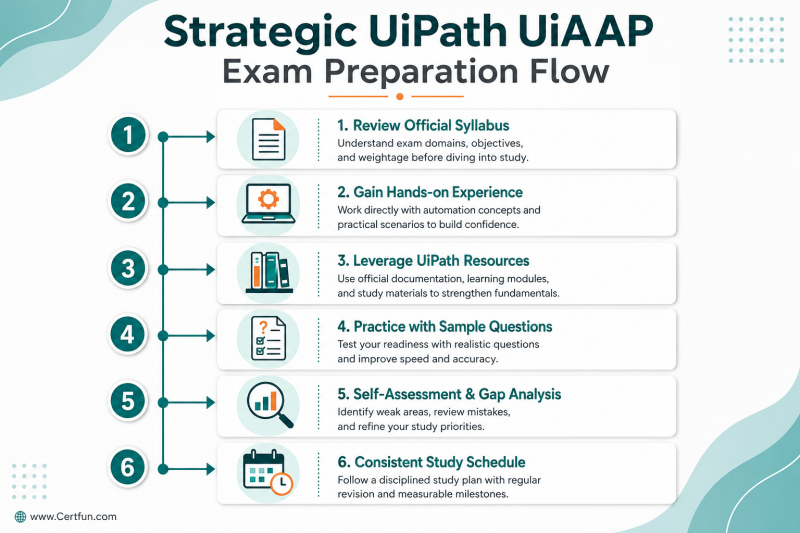
Effective preparation for the UiPath UiAAP certification requires a multi-faceted approach, combining foundational knowledge with hands-on experience and targeted study strategies. Given the advanced nature of the exam, candidates should possess a strong background in UiPath RPA and a solid understanding of AI/ML concepts. The journey to becoming UiAAP certified involves not just memorizing facts, but truly internalizing the principles of agentic automation and their practical application within the UiPath ecosystem.
One of the initial steps in a strategic preparation plan is to thoroughly review the official UiAAP exam description and syllabus. This will provide a clear roadmap of the topics and competencies that will be assessed. Candidates should then conduct a self-assessment to identify areas where their knowledge or experience might be weaker. Focusing efforts on these gaps will ensure a balanced understanding across all exam domains.
Hands-On Experience with Agentic Automation
Practical experience is indispensable for the UiPath UiAAP exam. Candidates should actively engage in projects that involve designing, developing, and deploying agentic automation solutions using the UiPath Platform. This means working with Agentic AI components, experimenting with prompt engineering, and integrating various UiPath products like Orchestrator and AI Center to build intelligent workflows. Hands-on application helps solidify theoretical knowledge and develops the problem-solving skills necessary for scenario-based exam questions. Building proof-of-concept solutions or contributing to real-world agentic projects will significantly enhance readiness.
Leveraging Official UiPath Resources
UiPath provides a wealth of official documentation, training courses, and community forums that are invaluable for UiAAP candidates. These resources offer deep dives into specific platform components, best practices for agentic automation, and guidance on implementation challenges. Participating in UiPath Academy courses relevant to Agentic AI and advanced automation can bridge knowledge gaps and provide structured learning. Engaging with the UiPath Community allows candidates to ask questions, share insights, and learn from the experiences of other professionals. Regularly reviewing the latest documentation ensures familiarity with new features and updates, which could be pertinent to the exam.
Effective Study Techniques and Practice
Beyond official resources, adopting effective study techniques is crucial. This includes creating a study schedule, breaking down complex topics into manageable segments, and utilizing various learning methods such as reading, watching tutorials, and actively coding. Regularly testing your knowledge through self-quizzes or mock exams can help identify areas that need further review. Understanding why an answer is correct or incorrect is as important as knowing the right answer. Collaboration with study groups can also provide diverse perspectives and reinforce understanding. Focusing on understanding the underlying concepts rather than rote memorization will lead to deeper and more lasting knowledge, which is essential for applying agentic principles in dynamic real-world scenarios.
Implementing the AI Trust Layer for Responsible Automation
A fundamental aspect of the UiPath UiAAP certification focuses on the ethical and responsible deployment of agentic automation, particularly through the implementation of the AI Trust Layer. As AI agents become more autonomous and integral to business operations, ensuring their trustworthiness, transparency, and fairness is paramount. The AI Trust Layer represents a critical framework for addressing potential risks associated with AI, including bias, data privacy, security vulnerabilities, and lack of explainability. Certified professionals are expected to understand how to design and implement agentic solutions that adhere to these ethical guidelines and regulatory requirements.
Implementing the AI Trust Layer involves several key considerations:
-
Transparency: Designing agents that can explain their decision-making process and actions, allowing stakeholders to understand why certain outcomes were reached.
-
Fairness: Mitigating algorithmic bias in agent behavior and data processing to ensure equitable treatment across different user groups and avoiding discriminatory outcomes.
-
Data Privacy and Security: Ensuring that agents handle sensitive data in compliance with regulations like GDPR or CCPA, and that robust security measures are in place to prevent unauthorized access or breaches.
-
Accountability: Establishing clear lines of responsibility for agent performance and outcomes, and implementing mechanisms for auditing and oversight.
-
Robustness: Building agents that are resilient to adversarial attacks, unexpected inputs, and operational failures, maintaining their integrity and reliability.
These elements collectively contribute to building confidence in agentic automation, fostering its wider adoption while safeguarding organizational values and compliance.
Agentic Automation: Transforming Business Workflows
Agentic automation is poised to revolutionize how businesses operate, transitioning from predefined, repetitive tasks to dynamic, intelligent workflows capable of adapting and learning. The UiPath UiAAP certification prepares professionals to be at the forefront of this transformation, empowering them to design and implement systems where AI agents take initiative, solve problems, and collaborate seamlessly with human teams. This shift promises not just efficiency gains but also enhanced innovation, improved decision-making, and a more responsive enterprise.
The transformative power of agentic automation is evident in several key areas:
-
Intelligent Document Processing: Agents can understand, extract, and process unstructured information from documents with human-like comprehension, improving data accuracy and speed.
-
Proactive Customer Service: Conversational agents equipped with context grounding can anticipate customer needs, resolve complex queries, and personalize interactions, leading to superior customer experiences.
-
Adaptive Process Optimization: UI Agents and Coded Agents can continuously monitor business processes, identify bottlenecks, and suggest or even implement optimizations autonomously, driving continuous improvement.
-
Enhanced Data Analysis: Agents can autonomously collect, synthesize, and analyze vast amounts of data, providing actionable insights that support strategic business decisions.
-
Self-Healing Systems: Through agentic evaluations and escalation mechanisms, intelligent agents can detect system anomalies, diagnose issues, and initiate corrective actions, reducing downtime and operational risks.
By embracing agentic automation, organizations can unlock new levels of operational excellence and strategic agility, allowing human talent to focus on higher-value, creative tasks. For additional resources and certification pathways, explore other opportunities to grow your expertise on Certfun’s platform.
Catalyzing Career Growth with UiPath UiAAP
Earning the UiPath UiAAP certification is a significant career accelerator for professionals in the automation and AI domains. In an era where intelligent automation is rapidly expanding, validated expertise in agentic solutions positions individuals as indispensable assets to their organizations. This credential not only enhances technical credibility but also opens doors to leadership roles in designing and implementing next-generation automation strategies. Professionals with the UiAAP certification are sought after for their ability to drive digital transformation initiatives, optimize complex workflows, and integrate cutting-edge AI capabilities into enterprise systems.
The demand for professionals skilled in Agentic AI is on a steep upward trajectory, reflecting the growing adoption of intelligent automation across industries. By securing the UiPath UiAAP, individuals demonstrate a proactive commitment to staying ahead of technological curves, proving their readiness to tackle the most challenging automation scenarios. This translates into increased earning potential, greater job security, and enhanced opportunities for career advancement into roles such as AI Solution Architect, Lead Automation Engineer, or Intelligent Automation Consultant. The certification validates a forward-thinking mindset and the practical skills to deliver tangible business value through advanced automation.
Conclusion
The UiPath UiAAP certification represents the pinnacle of expertise in agentic automation, marking a professional’s readiness to lead the charge in designing and deploying intelligent, adaptive solutions. By mastering the comprehensive syllabus, from core Agentic AI concepts to sophisticated orchestration with UiPath Maestro and the implementation of an AI Trust Layer, certified individuals are uniquely equipped to transform business processes. This credential is not merely a testament to technical skill but a strategic investment in a future where automation is seamlessly integrated with artificial intelligence, driving unparalleled efficiency and innovation.
For aspiring UiPath Agentic Automation Professionals, the journey toward certification demands dedication, hands-on practice, and a deep engagement with UiPath’s advanced tools and methodologies. Embracing this challenge will not only validate your expertise but also position you as a key player in shaping the next generation of intelligent enterprise. Elevate your automation career and confirm your proficiency in cutting-edge Agentic AI by pursuing this high-value certification. To further enhance your preparation and confidently approach your exam, explore detailed study guides and practice opportunities on the UiPath UiAAP certification page.
Frequently Asked Questions
1. Who should consider taking the UiPath UiAAP certification exam?
The UiPath UiAAP certification is ideal for experienced automation developers, solution architects, and technical consultants who have a strong foundation in UiPath RPA and are looking to specialize in designing and implementing agentic automation solutions.
2. What are the prerequisites for the UiPath UiAAP exam?
While there are no strict formal prerequisites, candidates are typically expected to have significant practical experience with the UiPath Platform and a foundational understanding of AI/ML concepts. Prior UiPath certifications, such as the Advanced RPA Developer, can be beneficial.
3. How long is the UiPath UiAAP certification valid?
Certification validity periods often vary by vendor. It is advisable to check the official UiPath certification program guidelines for the most current information regarding the validity and recertification policies for the UiAAP credential.
4. What kind of career opportunities does UiPath UiAAP certification unlock?
This certification can unlock advanced roles such as AI Solution Architect, Lead Automation Engineer, Intelligent Automation Consultant, or positions focused on developing and implementing next-generation automation strategies within an enterprise.
5. Are there any recommended study resources for the UiPath UiAAP exam?
Official UiPath Academy courses, documentation, and community forums are highly recommended. Additionally, practicing with sample questions and hands-on projects involving agentic automation can significantly enhance preparation.
- UiPath Certification |
- UiPath Certified Professional Agentic Automation Professional (UiAAP) |
- UiAAP Online Test |
- UiAAP Questions |
- UiAAP Quiz |
- UiAAP |
- UiPath UiAAP Certification |
- UiAAP Practice Test |
- UiAAP Study Guide |
- UiPath UiAAP Question Bank |
- UiAAP Certification Mock Test |
- Agentic Automation Professional Simulator |
- Agentic Automation Professional Mock Exam |
- UiPath Agentic Automation Professional Questions |
- Agentic Automation Professional |
- UiPath Agentic Automation Professional Practice Test |
- UiAAP Syllabus |
- UiAAP Books |
- UiAAP Certification Syllabus |
- UiPath Automation Professional Certification |
- UiPath UiAAP Books |
- UiPath UiAAP Training |
- Agentic Automation Professional Certification Cost |
- UiPath Agentic Automation Professional Books |
- UiPath Agentic Automation Professional Certification |
- UiAAP Sample Questions |
- UiPath UiAAP Practice Test Free |
- Agentic Automation Professional Certification Sample Questions


