
Is Huawei H13-731 the Big Data career game-changer?

Huawei H13-731, the Huawei Certified ICT Expert-Big Data-Data Mining certification, stands as a rigorous validation for seasoned Big Data professionals. This expert-level credential is meticulously designed for individuals who possess extensive knowledge and practical experience in Big Data technologies, particularly in data mining, analysis, and platform utilization. It targets engineers and architects aiming to demonstrate their advanced capabilities in designing, implementing, and optimizing complex Big Data solutions using Huawei's ecosystem. This comprehensive article delves into the intricacies of the Huawei H13-731 exam, exploring its syllabus, preparation strategies, and the significant career advantages it offers to those ready to distinguish themselves in the competitive Big Data landscape.
Defining the Huawei H13-731 Expertise
The Huawei H13-731 certification validates a candidate's advanced proficiency in Big Data and Data Mining principles, specifically within the Huawei ICT domain. Achieving this HCIE-level credential signifies a deep understanding of data processing, machine learning algorithms, and their application to real-world business challenges. Professionals pursuing this certification are typically senior Big Data engineers, data scientists, or solution architects with substantial hands-on experience looking to solidify their expert status. The exam ensures that certified individuals can competently leverage Huawei's Big Data platforms to extract meaningful insights and drive data-driven innovation. For detailed information on the skills validated, refer to the official H13-731 exam page.
Navigating the Huawei H13-731 Exam Structure
Candidates for the Huawei H13-731 exam must prepare for a demanding assessment that tests both theoretical knowledge and practical application. Understanding the format and requirements is crucial for effective study planning. The exam is structured to evaluate a broad spectrum of Big Data and Data Mining competencies, ensuring that successful candidates possess a well-rounded and expert-level skill set.
Core Exam Details for H13-731
The Huawei H13-731 exam comes with specific parameters that define its scope and assessment methodology:
-
Exam Name: Huawei Certified ICT Expert-Big Data-Data Mining
-
Exam Code: H13-731
-
Exam Price: $300 (USD)
-
Duration: 90 minutes
-
Number of Questions: 60
-
Passing Score: 600 / 1000
These details highlight the time-sensitive and knowledge-intensive nature of the H13-731, emphasizing the need for thorough and focused preparation to achieve the passing score.
Exploring Essential H13-731 Syllabus Topics
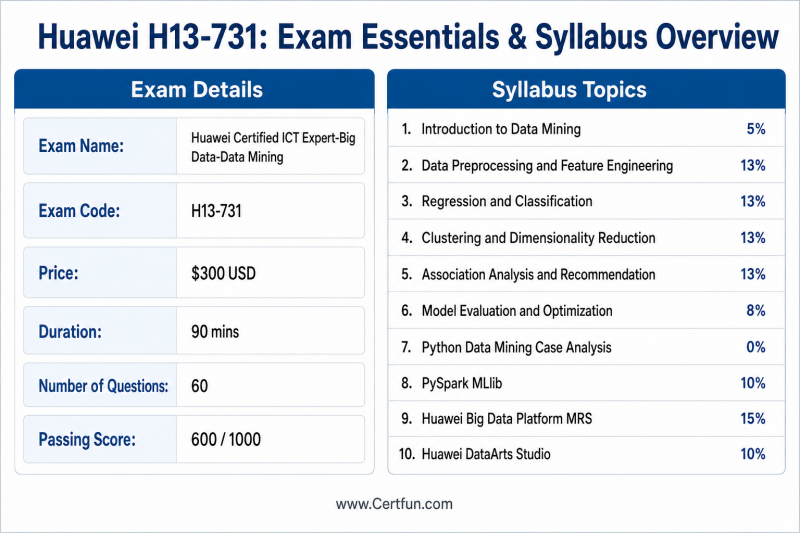
The Huawei H13-731 syllabus covers an extensive range of topics, ensuring that certified professionals are proficient in various aspects of Big Data and Data Mining. A granular understanding of these areas is indispensable for effective preparation and successful completion of the exam. The curriculum blends theoretical foundations with practical application on Huawei's Big Data platforms.
Fundamental Data Mining Concepts and Techniques
The exam begins with foundational aspects, building towards more complex topics:
-
Introduction to Data Mining (5%): Covers the basics, importance, and common applications of data mining.
-
Data Preprocessing and Feature Engineering (13%): Essential techniques for cleaning, transforming, and selecting features from raw data to optimize model performance.
Advanced Analytical Models and Algorithms
A significant portion of the syllabus focuses on the core algorithms and methodologies used in data analysis:
-
Regression and Classification (13%): Explores supervised learning techniques for predictive modeling.
-
Clustering and Dimensionality Reduction (13%): Unsupervised learning methods for pattern discovery and data simplification.
-
Association Analysis and Recommendation (13%): Techniques for finding relationships between variables and building recommendation systems.
-
Model Evaluation and Optimization (8%): Crucial methods for assessing model performance, tuning parameters, and improving accuracy.
Practical Application with Big Data Tools
The H13-731 syllabus integrates real-world application, emphasizing hands-on skills with popular and proprietary platforms:
-
Python Data Mining Case Analysis (0%): While listed, it carries no weight, implying its integration across other practical sections or as an underlying skill.
-
PySpark MLlib (10%): Demonstrates proficiency in using Spark's machine learning library for scalable data mining tasks.
-
Huawei Big Data Platform MRS (15%): In-depth knowledge of Huawei's MapReduce Service (MRS) for Big Data processing and analytics.
-
Huawei DataArts Studio (10%): Expertise in using Huawei's comprehensive data development and governance platform for Big Data solutions.
This comprehensive curriculum ensures that candidates possess both theoretical expertise and practical experience with industry-standard and Huawei-specific tools.
Elevating Big Data Capabilities with HCIE Data Mining
Achieving the HCIE-Big Data-Data Mining certification significantly elevates a professional’s standing in the Big Data domain. This credential signifies more than just theoretical understanding; it validates a deep-seated ability to apply complex data mining techniques to large datasets, extract actionable intelligence, and contribute to strategic decision-making. The skills acquired and validated through the H13-731 exam are directly transferable to roles requiring advanced data analysis, predictive modeling, and the optimization of Big Data pipelines, positioning the certified individual as a leader in data-driven initiatives. This level of expertise is critical for organizations seeking to derive maximum value from their vast data repositories.
Strategic Preparation for Huawei H13-731 Success
Passing the Huawei H13-731 exam requires a structured and dedicated approach to preparation. Given its expert-level designation, mere superficial study is insufficient. Candidates must commit to a thorough review of all syllabus topics, reinforcing concepts with practical application. Effective preparation involves a combination of official training, hands-on labs, and rigorous self-assessment to ensure mastery of both theoretical foundations and platform-specific implementations.
Leveraging Diverse Study Resources
Successful candidates often combine various resources to cover the breadth and depth of the H13-731 syllabus.
-
Official Huawei Training: Enrolling in authorized Huawei training programs is highly recommended. These courses are designed to align directly with the exam objectives and provide expert instruction.
-
Study Guides and Documentation: Utilize official Huawei documentation, whitepapers, and comprehensive study guides that specifically cover the H13-731 exam topics and Huawei's Big Data solutions.
-
Online Learning Platforms: Supplement formal training with online courses, webinars, and tutorials focusing on Big Data, data mining algorithms, PySpark MLlib, and Python for data analysis.
A well-rounded study plan should integrate these resources to build a solid knowledge base.
The Value of Consistent Practice Exams
Regular self-assessment through practice exams is indispensable for H13-731 exam preparation. These tools help candidates familiarize themselves with the exam format, identify knowledge gaps, and improve time management skills. Simulating the actual exam environment allows for a realistic assessment of readiness. Engaging with authentic practice questions can significantly boost confidence and highlight areas requiring further study. Remember, consistent practice is key to converting knowledge into performance under exam conditions.
Adhering to Ethical Preparation Guidelines
In the pursuit of any professional certification, maintaining integrity is paramount. Relying on unauthorized "exam dumps" undermines the value of the certification and professional credibility. Instead, focus on legitimate study materials, official courses, and reputable practice tests. Ethical preparation ensures that the knowledge and skills gained are genuine, preparing you not just to pass an exam, but to excel in real-world Big Data roles. Huawei's certifications are designed to validate true expertise, and shortcuts detract from this objective.
Unlocking Career Growth with Huawei Certified ICT Expert
The Huawei Certified ICT Expert-Big Data-Data Mining (H13-731) certification serves as a powerful accelerator for career progression in the Big Data domain. Attaining the HCIE designation signals to employers a rare level of expertise and commitment. Professionals with this certification are recognized for their capability to tackle the most complex data challenges, from designing scalable data processing architectures to implementing sophisticated machine learning models. This elite credential can lead to advanced roles such as Principal Data Scientist, Big Data Architect, or Machine Learning Engineer, often associated with a competitive Huawei Certified ICT Expert salary and increased professional responsibility.
Tangible H13-731 Certification Benefits
Beyond personal satisfaction, the H13-731 certification offers several concrete advantages:
-
Enhanced Credibility: Positions you as an industry expert in Big Data and Data Mining.
-
Career Advancement: Opens doors to senior and leadership positions within organizations.
-
Increased Earning Potential: HCIE-level certifications are often linked to higher salaries and better compensation packages.
-
Global Recognition: Huawei's global presence ensures that your certification is recognized worldwide.
-
Strategic Impact: Equips you with the skills to drive significant business value through data-driven insights.
These benefits collectively make the H13-731 a strategic investment in one’s professional future, validating advanced Big Data competencies.
Assessing the H13-731 Exam Difficulty
The Huawei H13-731 exam is renowned for its high difficulty, reflecting its status as an expert-level certification. It demands not only a deep theoretical understanding of Big Data and Data Mining concepts but also extensive practical experience in applying these principles, particularly within Huawei's technological ecosystem. Candidates should expect questions that test their analytical thinking, problem-solving abilities, and their proficiency with tools like PySpark MLlib, Huawei MRS, and DataArts Studio. The passing score of 600 out of 1000, combined with a 90-minute duration for 60 questions, further underscores the need for precision and speed. The H13-731 exam difficulty necessitates comprehensive study and hands-on preparation to succeed.
Implementing Data Mining Solutions with Huawei Technologies
A significant aspect of the Huawei H13-731 certification lies in its focus on practical implementation using Huawei's Big Data technologies. The exam ensures that certified professionals are not just theoretically sound but are also capable of deploying and managing real-world data mining solutions within the Huawei ecosystem. This includes expertise in leveraging the robust capabilities of Huawei Big Data Platform MRS and Huawei DataArts Studio.
Harnessing Huawei Big Data Platform MRS
Huawei's MapReduce Service (MRS) is a cornerstone of its Big Data offerings, and the H13-731 exam expects a thorough understanding of its architecture, deployment, and operational aspects. Professionals must demonstrate their ability to use MRS for:
-
Large-scale data processing and storage.
-
Integrating various Big Data components such as Hadoop, Hive, and Spark.
-
Optimizing resource utilization and performance for data-intensive workloads.
Proficiency in MRS is vital for building scalable and efficient Big Data infrastructures.
Mastering Huawei DataArts Studio
Huawei DataArts Studio is designed as a one-stop platform for data development, governance, and operations. For H13-731 candidates, this translates to demonstrating competence in:
-
Designing and developing data integration pipelines.
-
Applying data quality and data governance rules.
-
Orchestrating complex data workflows for data mining projects.
Expertise in DataArts Studio allows professionals to manage the entire lifecycle of a Big Data project, from raw data ingestion to insightful analytics, making it a critical skill validated by the certification.
Building a Robust Study Plan for HCIE Data Mining
Developing a systematic and robust study plan is essential for anyone aiming to conquer the HCIE Data Mining exam. This plan should account for the depth of the syllabus, the practical components, and the expert-level expectations. A phased approach ensures that foundational knowledge is solidified before moving on to more advanced and platform-specific topics, optimizing learning efficiency and retention.
Mastering Syllabus Components Incrementally
Break down the H13-731 syllabus into manageable sections. Start with the "Introduction to Data Mining" and "Data Preprocessing and Feature Engineering" to build a strong base. Progress to "Regression and Classification," "Clustering," and "Association Analysis," focusing on understanding the underlying algorithms and their applications. Allocate sufficient time for "Model Evaluation and Optimization," as it ties all analytical techniques together. This incremental approach prevents overwhelm and allows for focused learning.
Emphasizing Hands-on Practice and Labs
Theoretical knowledge must be complemented by practical experience. Dedicate significant time to hands-on labs and case studies, especially involving PySpark MLlib and Huawei's platforms.
-
Practice implementing algorithms in Python and PySpark.
-
Work with datasets to perform data preprocessing, model training, and evaluation.
-
Familiarize yourself with the interfaces and functionalities of Huawei Big Data Platform MRS and Huawei DataArts Studio through practical exercises.
Practical application solidifies understanding and prepares candidates for the scenario-based challenges often present in expert-level exams.
Validating Advanced Big Data Competencies
The Huawei H13-731 certification offers a robust mechanism for validating advanced Big Data competencies, positioning it as a true career game-changer. It assures employers that a certified professional possesses not only a comprehensive theoretical grasp of data mining but also the practical acumen to apply these complex methodologies effectively. This expert-level validation is crucial in a market that increasingly values demonstrated capability over mere familiarity with concepts. Companies investing in Big Data solutions require personnel who can architect, implement, and manage sophisticated data pipelines and analytical models, precisely what the H13-731 validates.
Choosing Quality H13-731 Study Materials
Selecting the right study materials is a critical step in preparing for the Huawei H13-731 exam. Given the comprehensive nature and advanced difficulty, substandard resources can hinder progress. Prioritize official Huawei documentation, recommended textbooks, and reputable training courses that align precisely with the H13-731 exam topics and objectives. Look for materials that offer a blend of theoretical explanations, practical exercises, and sample questions to ensure a holistic preparation experience. For those seeking comprehensive H13-731 study resources, exploring platforms known for quality certification content can provide a significant advantage.
Sustaining Your Big Data Expertise
Achieving the Huawei H13-731 certification marks a significant milestone, but the journey of a Big Data professional is one of continuous learning. The Big Data landscape evolves rapidly, with new technologies, algorithms, and best practices emerging constantly. Maintaining your HCIE status and relevance in the field requires ongoing engagement with industry developments, participation in communities, and continuous skill refinement. Regularly reviewing new releases of Huawei's platforms, exploring advanced data mining techniques, and applying learned skills to new challenges will ensure that your expertise remains sharp and valuable throughout your career.
Conclusion
The Huawei H13-731 certification is undeniably a transformative credential for Big Data professionals. It’s an expert-level validation that distinguishes individuals capable of tackling advanced data mining challenges and leveraging Huawei’s Big Data ecosystem. By mastering the comprehensive syllabus, engaging in rigorous preparation, and demonstrating a deep understanding of complex algorithms and platform implementations, candidates can unlock significant career growth and contribute meaningfully to the data-driven future of organizations. This HCIE certification transcends a simple qualification; it represents a commitment to excellence and a pivotal step in becoming an indispensable Big Data expert.
Are you ready to elevate your Big Data career and solidify your expertise with an industry-recognized certification? Begin your journey towards becoming a Huawei Certified ICT Expert in Big Data-Data Mining today. Explore more expert certification pathways and discover the resources that can guide your preparation.
Frequently Asked Questions
1. What is the Huawei H13-731 certification intended for?
The Huawei H13-731 certification, known as Huawei Certified ICT Expert-Big Data-Data Mining, is intended for senior Big Data professionals, data scientists, and architects. It validates expert-level skills in data mining theory, algorithms, and practical application using Huawei's Big Data platforms like MRS and DataArts Studio.
2. How does the H13-731 exam enhance a Big Data professional's career?
The H13-731 exam enhances a Big Data professional's career by validating advanced expertise, increasing credibility, opening doors to senior roles, and potentially leading to higher earning potential. It signifies a capability to design and implement complex data mining solutions, making certified individuals highly sought after.
3. What are the key areas covered in the H13-731 syllabus?
The H13-731 syllabus covers an extensive range of topics including Introduction to Data Mining, Data Preprocessing, Regression and Classification, Clustering, Association Analysis, Model Evaluation, PySpark MLlib, Huawei Big Data Platform MRS, and Huawei DataArts Studio.
4. Is the Huawei H13-731 certification recognized globally?
Yes, as an HCIE (Huawei Certified ICT Expert) certification, the H13-731 is recognized globally. Huawei has a significant international presence, ensuring that its top-tier certifications hold weight and are respected by employers worldwide, enhancing career opportunities on an international scale.
5. What kind of preparation is recommended for the H13-731 exam?
Recommended preparation for the H13-731 exam includes attending official Huawei training, studying comprehensive guides, gaining hands-on experience with Big Data platforms and tools (especially Huawei's), and utilizing reputable practice tests. A structured study plan focusing on both theoretical and practical aspects is crucial.
- Huawei Certification |
- Huawei Cloud Platform & Cloud Services Certification |
- Huawei Certified ICT Expert-Big Data-Data Mining |
- H13-731 HCIE-Big Data-Data Mining |
- H13-731 Online Test |
- H13-731 Questions |
- H13-731 Quiz |
- H13-731 |
- Huawei HCIE-Big Data-Data Mining Certification |
- HCIE-Big Data-Data Mining Practice Test |
- HCIE-Big Data-Data Mining Study Guide |
- Huawei H13-731 Question Bank |
- HCIE-Big Data-Data Mining Certification Mock Test |
- HCIE-Big Data-Data Mining Simulator |
- HCIE-Big Data-Data Mining Mock Exam |
- Huawei HCIE-Big Data-Data Mining Questions |
- HCIE-Big Data-Data Mining |
- Huawei HCIE-Big Data-Data Mining Practice Test |
- H13-731 Syllabus |
- HCIE-Big Data-Data Mining Books |
- HCIE-Big Data-Data Mining Certification Syllabus |
- Huawei H13-731 Books |
- Huawei HCIE-Big Data-Data Mining Training |
- HCIE-Big Data-Data Mining Certification Cost |
- Huawei HCIE-Big Data-Data Mining Books |
- HCIE-Big Data-Data Mining Sample Questions |
- Huawei H13-731 Practice Test Free |
- HCIE-Big Data-Data Mining Certification Sample Questions


