
Get Started with H31-421: Essential Exam Overview
 Huawei's H31-421 examination, leading to the Huawei Certified ICT Professional-LTE (HCIP-LTE) certification, validates an individual’s expertise in advanced LTE technologies. This credential is designed for professionals seeking to demonstrate deep understanding and practical skills in LTE air interface, signaling protocols, eNodeB reconfiguration, and advanced troubleshooting within complex network environments. Successfully passing the H31-421 exam signifies a candidate's readiness to plan, deploy, maintain, and optimize Huawei LTE networks. This comprehensive guide will clarify the H31-421 exam objectives, structure, and essential preparation strategies to help aspiring professionals navigate their path to becoming an HCIP-LTE certified expert.
Navigating the H31-421 Exam Blueprint
The H31-421 exam is a critical step for ICT professionals aiming to specialize in LTE technology. Understanding its fundamental components is crucial for effective preparation. This exam evaluates a candidate's practical and theoretical knowledge through a structured format designed to assess a broad range of competencies in Huawei's LTE solutions. The exam's design reflects real-world challenges encountered in modern telecommunications.
Key details about the H31-421 examination include:
- Exam Name: Huawei Certified ICT Professional-LTE
- Exam Code: H31-421
- Exam Price: $300 (USD)
- Duration: 90 minutes
- Number of Questions: 60
- Passing Score: 600 out of 1000
These specifications highlight the need for efficient time management and a solid grasp of the subject matter to achieve a passing score within the allocated time. Candidates should review these details thoroughly on the official Huawei certification portal to ensure they are fully prepared for the testing environment.
Core Competencies: H31-421 Syllabus Breakdown
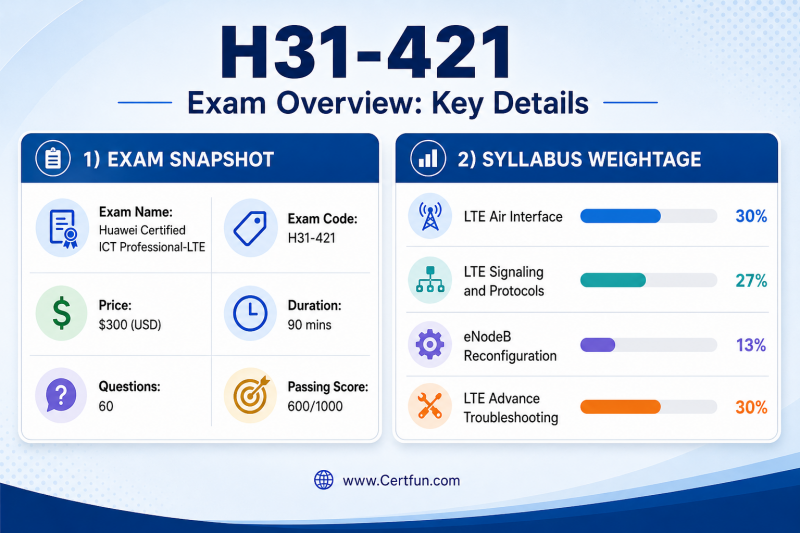 The H31-421 exam syllabus is meticulously structured to cover essential domains required for a Huawei Certified ICT Professional-LTE. Each domain is weighted, indicating its significance in the overall exam. Candidates must allocate their study time proportionally to these percentages to maximize their chances of success.
The key areas of focus within the H31-421 syllabus are:
-
LTE Air Interface (30%): This section delves into the fundamental principles and technologies governing the wireless communication between user equipment and the eNodeB in an LTE network. It encompasses topics like physical layer concepts, radio resource management, and various air interface features crucial for efficient network operation.
-
LTE Signaling and Protocols (27%): A substantial portion of the exam focuses on the intricate signaling procedures and protocols that enable communication and service delivery within the LTE core and radio access networks. Understanding these protocols is vital for managing network connections and ensuring seamless data flow.
-
eNodeB Reconfiguration (13%): This domain covers the processes and considerations involved in reconfiguring eNodeB equipment, which is critical for network upgrades, optimization, and maintaining service quality. It examines the practical aspects of modifying network elements to adapt to changing requirements.
-
LTE Advance Troubleshooting (30%): Equating to the largest portion of the exam, this section tests a candidate's ability to diagnose and resolve complex issues within an LTE network. It demands a deep understanding of fault isolation, performance analysis, and problem-solving techniques to maintain network stability and reliability.
A balanced approach to these domains, with particular emphasis on troubleshooting and air interface, will be instrumental in mastering the exam content.
Unlocking Career Potential with HCIP-LTE Validation
Achieving the Huawei Certified ICT Professional-LTE (H31-421) certification offers significant advantages for professionals in the telecommunications sector. This credential not only validates advanced technical skills but also positions individuals for enhanced career growth and increased recognition within the industry. By earning the HCIP-LTE, certified experts demonstrate a profound capability in managing and optimizing complex LTE infrastructures.
The benefits extend across various aspects of a professional's career trajectory:
-
Enhanced Expertise: The certification signifies a high level of proficiency in LTE technology, ensuring that professionals are well-versed in the latest Huawei solutions and industry best practices. This depth of knowledge is invaluable for tackling advanced network challenges.
-
Career Advancement: HCIP-LTE certification often opens doors to more senior roles, such as LTE network engineers, optimization specialists, and technical consultants. Employers highly value certified individuals for their proven skill sets.
-
Increased Employability: In a competitive job market, certifications act as a powerful differentiator, making candidates more attractive to potential employers seeking specialized talent in mobile communication technologies.
-
Industry Recognition: Huawei certifications are globally recognized, providing a badge of credibility that underscores a professional's commitment to continuous learning and technical excellence within the ICT domain.
-
Higher Earning Potential: With validated, in-demand skills, certified professionals typically command higher salaries and better compensation packages compared to their non-certified counterparts.
This certification is more than just a piece of paper; it represents a commitment to excellence and a significant investment in one's professional future, especially in the rapidly evolving landscape of mobile networks.
Effective Strategies for H31-421 Exam Preparation
Successful preparation for the H31-421 exam requires a structured and consistent approach. Given the depth and breadth of the syllabus, candidates should develop a comprehensive study plan that incorporates various resources and techniques. Ethical preparation, avoiding the use of unauthorized materials, is paramount for building genuine expertise and long-term career success.
A robust preparation strategy includes:
-
Official Huawei Training: Enrolling in official Huawei-led or authorized training courses provides structured learning, often delivered by experienced instructors who can offer practical insights and clarify complex concepts. These courses are typically aligned with the latest exam objectives.
-
Detailed Study Guide Utilization: Referencing a high-quality H31-421 study guide is crucial for organizing your learning. A good guide breaks down the syllabus topics, offers explanations, and helps identify key areas for deeper focus.
-
Hands-On Practice: Practical experience with LTE equipment and network configurations is invaluable. Where possible, engage in lab exercises or simulations that mimic real-world scenarios to solidify theoretical knowledge.
-
Regular Practice Tests: Taking H31-421 practice tests is essential for assessing your understanding, identifying weak areas, and familiarizing yourself with the exam format and question types. Resources like H31-421 sample questions can provide valuable exposure.
-
Reviewing LTE Fundamentals: Ensure a strong foundation in general LTE principles before diving into advanced Huawei-specific topics. This foundational knowledge will make it easier to grasp the more intricate concepts covered in the exam.
Consistently applying these strategies, combined with dedicated study time, will significantly enhance your readiness for the H31-421 certification exam.
Mastering Advanced Troubleshooting for H31-421 Success
The 30% weightage of "LTE Advance Troubleshooting" in the H31-421 exam syllabus underscores its critical importance. This section demands more than just theoretical knowledge; it requires a practical mindset for identifying, diagnosing, and resolving complex issues in a live LTE network environment. Professionals must be adept at interpreting network data, understanding alarm patterns, and applying logical deduction to pinpoint root causes.
Key areas to focus on for troubleshooting mastery include:
-
Performance Degradation Analysis: Understanding common indicators of performance issues, such as low throughput, high latency, or frequent drops, and knowing how to systematically investigate their origins. This involves familiarity with key performance indicators (KPIs) and their thresholds.
-
Alarm and Event Management: Proficiency in interpreting eNodeB alarms, understanding their severity, and knowing the appropriate response procedures. This also extends to analyzing system logs and event traces for diagnostic purposes.
-
Signaling Flow Analysis: Being able to trace and understand the various signaling messages exchanged between network elements (UE, eNodeB, MME, SGW, PGW) during different procedures (e.g., attach, handover, call setup). Troubleshooting often involves pinpointing where a signaling sequence breaks down.
-
Interference Identification and Mitigation: Knowledge of different types of interference in an LTE network (e.g., intra-system, inter-system) and techniques for identifying their sources and implementing effective mitigation strategies to improve network quality.
-
Problem Isolation Techniques: Developing a methodical approach to narrow down the scope of a problem, involving steps like checking physical layer connectivity, verifying configuration settings, and examining software versions.
A strong focus on these practical troubleshooting skills, ideally supplemented by lab practice, will be instrumental in excelling in this challenging but crucial domain of the H31-421 exam.
Sustaining Momentum: Continuous Learning in LTE
The field of telecommunications, particularly LTE and its evolution towards 5G, is in a constant state of flux. Earning the Huawei H31-421 certification marks a significant milestone but also highlights the importance of continuous learning. To remain a valuable asset in the ICT industry, professionals must actively engage with new developments, emerging standards, and updated Huawei technologies. This proactive approach ensures that certified expertise remains relevant and applicable to future challenges.
Maintaining your edge involves:
-
Staying Updated on 3GPP Releases: Following the latest 3GPP specifications and enhancements for LTE and 5G helps you understand the evolution of mobile networks and anticipate future requirements.
-
Exploring Huawei Product Innovations: Huawei consistently introduces new features and solutions for its LTE and 5G portfolio. Regularly reviewing product documentation and technical whitepapers can keep your knowledge current.
-
Participating in Industry Forums: Engaging with fellow professionals in online communities, webinars, and conferences provides opportunities to share knowledge, learn from peers, and stay informed about industry trends and best practices.
-
Pursuing Advanced Certifications: Building upon the HCIP-LTE, consider higher-level Huawei certifications or specialized tracks in areas like 5G, cloud core, or network automation to broaden your skill set and career prospects.
-
Applying Knowledge in Real-World Projects: Actively seeking opportunities to implement and utilize your HCIP-LTE knowledge in practical projects reinforces learning and helps you adapt to new technical challenges.
Embracing a mindset of continuous improvement is not just beneficial but essential for long-term success as an HCIP-LTE professional in the dynamic world of ICT.
Conclusion
The Huawei H31-421 exam is a gateway to demonstrating advanced proficiency in LTE technology. By understanding its structure, dedicating time to each syllabus domain, and adopting a rigorous preparation strategy, candidates can significantly improve their chances of success. This certification not only validates your expertise in complex Huawei LTE solutions but also provides a strong foundation for career advancement in the rapidly evolving telecommunications landscape. Invest in your professional development and solidify your position as a skilled HCIP-LTE professional.
Embark on your journey to becoming a Huawei Certified ICT Professional-LTE. Explore comprehensive study resources and practice materials to ensure you're fully prepared for the H31-421 examination. Begin your path to HCIP-LTE certification today.
Frequently Asked Questions
1. What does the H31-421 certification validate?
The H31-421 certification, also known as Huawei Certified ICT Professional-LTE, validates a professional's advanced knowledge and practical skills in Huawei LTE network deployment, optimization, maintenance, and troubleshooting.
2. Who should consider taking the H31-421 exam?
ICT professionals, network engineers, LTE solution architects, and technical support personnel who work with Huawei LTE networks and aspire to advance their expertise and career in mobile communication technologies should consider this exam.
3. How difficult is the H31-421 exam?
The H31-421 exam is considered a professional-level certification, requiring a deep understanding of LTE theory and practical application. Its difficulty is moderate to high, demanding thorough preparation across all syllabus domains.
4. What are the prerequisites for the H31-421 exam?
While there are typically no strict formal prerequisites for taking the H31-421 exam, candidates are generally expected to have foundational knowledge of mobile communication principles and ideally some experience with Huawei technologies.
5. How long is the H31-421 certification valid?
Huawei certifications typically have a validity period of three years. To maintain your certification status, you may need to recertify by passing the same exam again, passing a higher-level exam, or passing an equivalent continuing education exam before your current certification expires.
- Huawei Certification |
- Huawei ICT Infrastructure Certification |
- Huawei Certified ICT Professional-LTE |
- H31-421 HCIP-LTE |
- H31-421 Online Test |
- H31-421 Questions |
- H31-421 Quiz |
- H31-421 |
- Huawei HCIP-LTE Certification |
- HCIP-LTE Practice Test |
- HCIP-LTE Study Guide |
- Huawei H31-421 Question Bank |
- HCIP-LTE Certification Mock Test |
- HCIP-LTE Simulator |
- HCIP-LTE Mock Exam |
- Huawei HCIP-LTE Questions |
- HCIP-LTE |
- Huawei HCIP-LTE Practice Test |
- H31-421 Syllabus |
- HCIP-LTE Books |
- HCIP-LTE Certification Syllabus |
- Huawei H31-421 Books |
- Huawei HCIP-LTE Training |
- HCIP-LTE Certification Cost |
- HCIP-LTE Sample Questions |
- Huawei H31-421 Practice Test Free |
- HCIP-LTE Certification Sample Questions


