
Atlassian Managing Jira Projects for Cloud (ACP-620) Certification Sample Questions
 Getting knowledge of the Atlassian ACP-620 exam structure and question format is vital in preparing for the Atlassian Managing Jira Projects for Cloud certification exam. Our Atlassian Managing Jira Projects for Cloud sample questions offer you information regarding the question types and level of difficulty you will face in the real exam. The benefit of using these Atlassian ACP-620 sample questions is that you will get to check your preparation level or enhance your knowledge by learning the unknown questions. You will also get a clear idea of the exam environment and exam pattern you will face in the actual exam with the Atlassian Managing Jira Projects for Cloud Sample Practice Test. Therefore, solve the Atlassian Managing Jira Projects for Cloud sample questions to stay one step forward in grabbing the Atlassian Certified Professional - Managing Jira Projects for Cloud credential.
These Atlassian ACP-620 sample questions are simple and basic questions similar to the actual Atlassian Managing Jira Projects for Cloud questions. If you want to evaluate your preparation level, we suggest taking our Atlassian Managing Jira Projects for Cloud Premium Practice Test. You might face difficulties while solving the real-exam-like questions. But, you can work hard and build your confidence on the syllabus topics through unlimited practice attempts.
Atlassian ACP-620 Sample Questions:
Which permissions does Dom need, at minimum, to complete the sprint?
(Choose two.)
a) Edit Issues
b) Schedule Issues
c) Manage Sprints
d) Transition Issues
e) Move Issues
f) Browse Projects
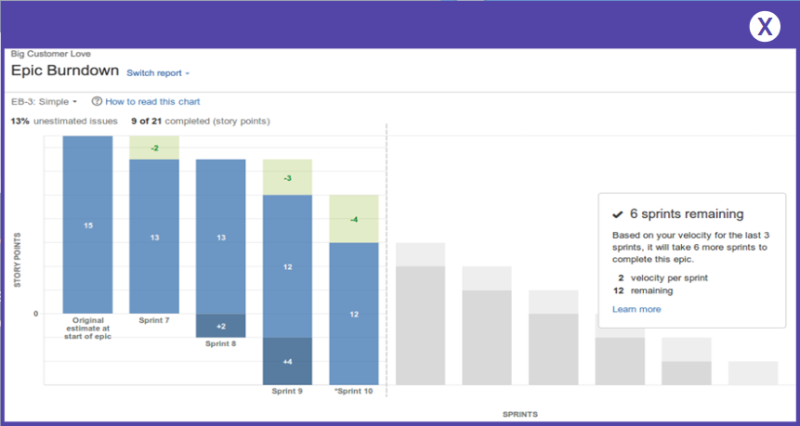
(Choose two.)
a) 10% of issues in the epic are unestimated.
b) The epic is predicted to complete in 6 weeks.
c) There are a total of 21 issues in the epic.
d) Since work started, 6 story points have been added to the epic.
e) 9 story points have been completed in the epic.
f) No further story points will be added to the epic.
Which actions can you perform?
(Choose three.)
a) Create TIS sub-tasks underneath DEV stories.
b) Assign TIS issues to versions that belong to DEV.
c) Rank some DEV issues above TIS issues in the backlog.
d) Make DEV issues children of an epic in TIS.
e) Link TIS sub-tasks to DEV stories.
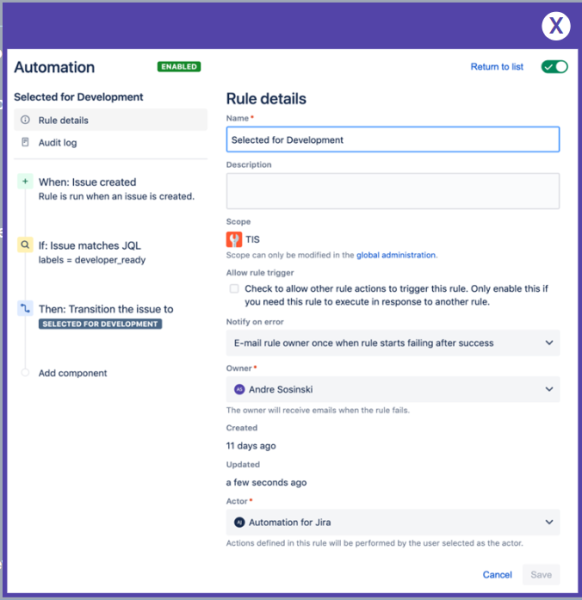
(Choose two.)
a) Jon did not add the developer_ready label when he created the issue
b) Jon created the issue in the TIS project
c) TIS is a company-managed project
d) Selected for Development is not reachable in the TIS workflow
e) Jon does not have the Transition Issues permission in the TIS project
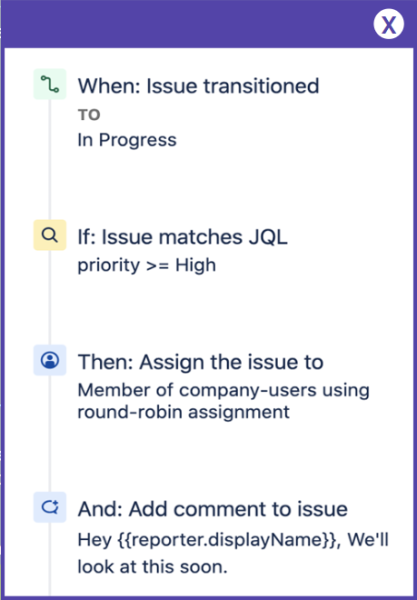
What is the most likely cause?
a) The JQL in the condition is invalid.
b) The priority does not satisfy the priority >= High condition.
c) The issue was transitioned to a status other than In Progress.
d) The issue remained in the To Do status.
e) Members of company-users lack the Assignable User permission.
The team wants her to manage sprints and work on issues without gaining control of project settings and without exposing the project to anyone else. What should you do?
a) Keep her as a Viewer and request a change to her product access.
b) Change the project access to Open.
c) Change the project access to Limited.
d) Change her project role to Administrator.
e) Change her project role to Member.
a) Create a second backlog column and split the issues between the two columns
b) Enable the Kanban backlog
c) Create a new status and column, then leave that status unmapped
d) Edit the board filter to exclude the Backlog status
Which issue type can be added to an issue already in the active sprint without the burndown chart indicating a scope change?
a) Sub-task
b) Bug
c) Task
d) Story
Which access level should Dom choose?
a) Limited
b) Private
c) Open
d) Public
Which actions would enable them to do so?
(Choose three.)
a) Add them to a group that is granted the Manage Sprints permission in the project's permission scheme.
b) Grant them the Manage Sprints permission as individual users in the permission scheme.
c) Add them as board administrators of the Scrum board that holds the sprints.
d) Add them to a project role that is granted the Manage Sprints permission.
e) Grant them the Schedule Issues permission as individual users in the permission scheme.
f) Add them to a group that has Jira Software application access on the site.
Answers:
|
Question: 01 Answer: c, f |
Question: 02 Answer: d, e |
Question: 03 Answer: c, d, e |
Question: 04 Answer: a, d |
Question: 05 Answer: e |
|
Question: 06 Answer: e |
Question: 07 Answer: b |
Question: 08 Answer: a |
Question: 09 Answer: c |
Question: 10 Answer: a, b, d |
Note: For any error in Atlassian Managing Jira Projects for Cloud (ACP-620) certification exam sample questions, please update us by writing an email on feedback@certfun.com.
- ACP-620 Questions |
- ACP-620 Quiz |
- ACP-620 |
- Atlassian ACP-620 Question Bank |
- Atlassian ACP-620 Practice Test Free |
- Atlassian Managing Jira Projects for Cloud Certification |
- Managing Jira Projects for Cloud |
- Managing Jira Projects for Cloud Mock Exam |
- Managing Jira Projects for Cloud Certification Sample Questions |
- Managing Jira Projects for Cloud Sample Questions


